Last updated: November 2026
A watch is one of the hardest objects in retail to light well. The dial wants to glow, the sapphire crystal wants to reflect your spotlight straight back into the customer’s eye, the metal bracelet throws hot specular flares, and the leather strap – if you light it too hard for too long – slowly dries and fades. Watch display case lighting has to hit a narrow window: bright enough to make the dial readable and the case steel sparkle, controlled enough to kill reflections, and gentle enough to protect leather, lacquer and lume.
This guide covers the specification decisions that matter for watch cabinets, watch walls, single-watch vitrines and winder cabinets, with layout patterns by case type. Every product mentioned is a real model we manufacture, with its published figures – no invented specs.
Why watches are harder to light than jewelry
Three things make a watch difficult that a ring or pendant does not:
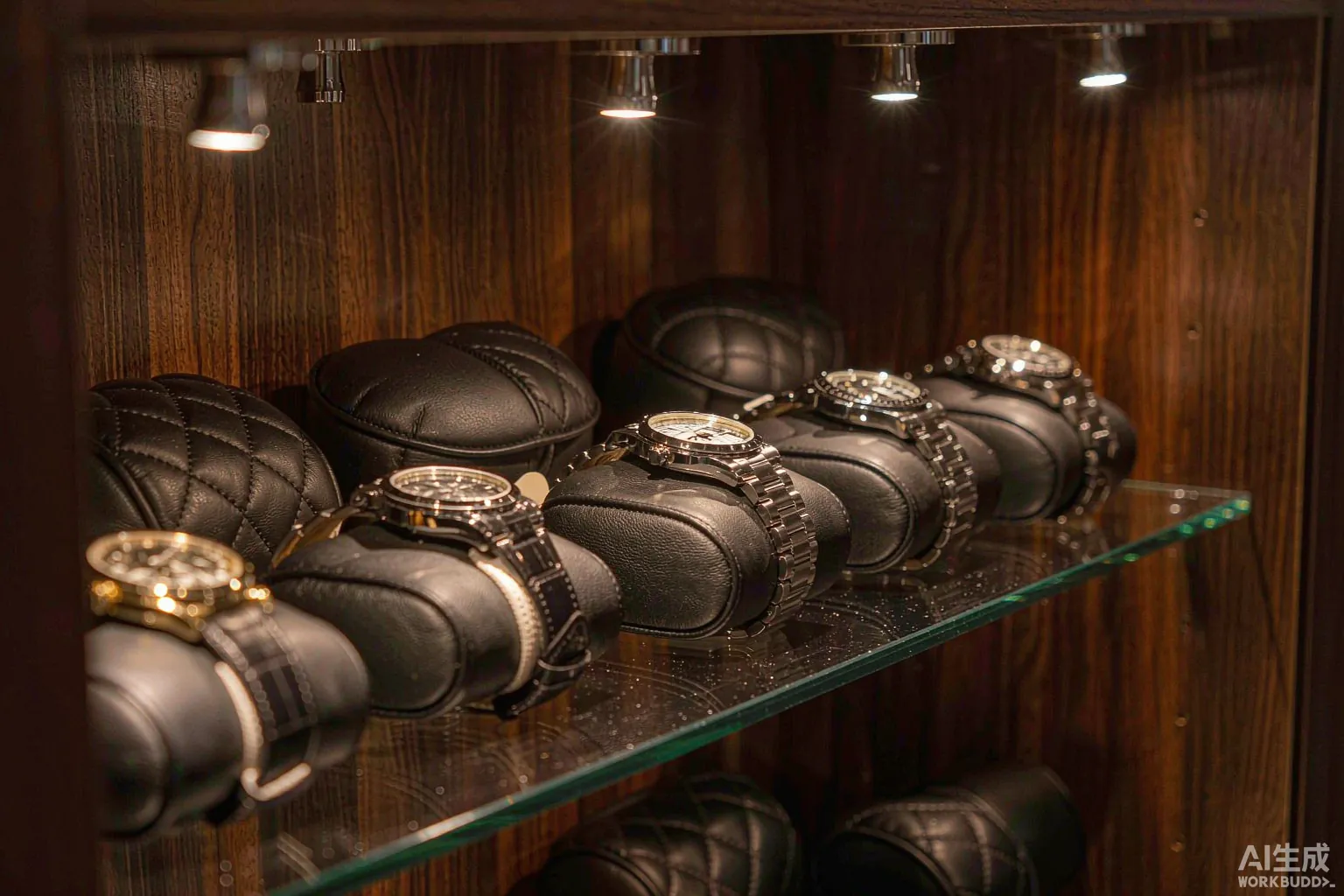
- A flat, horizontal or angled dial under vertical glass. The spotlight comes down at an angle, the sapphire crystal bounces part of it toward the viewer, and suddenly the customer sees your ceiling, not the dial. Reflection management is the whole game.
- Mixed materials in one object. Brushed steel, polished gold, sunburst blue dials, matte black ceramics, rubber, leather. One light cannot flatter all of them; per-watch aiming is what separates a watch cabinet that sells from one that glares.
- Organic materials with a shelf life. Leather and exotic-skin straps are the only “living” materials in most watch cases. They age under cumulative light exposure – the same physics museums manage with lux-hour budgets, just at retail scale.
The five specification decisions
1. Color rendering: CRI 90 minimum
Dial colors are where watches live or die commercially. A sunburst blue dial, a salmon face, a green ceramic bezel – these are the colors customers photograph and post. A CRI 80 fixture flattens exactly these saturated metal-flake tones. Use CRI 90 or better; our OSRAM-chipped heads (CHIB7514-P-1W, CHIB7520-3P-1W) publish Ra ≥ 90.
2. Color temperature: usually 3000K, sometimes 4000K
Traditional watch retail leans warm – 3000K makes gold and rose-gold cases glow and flatters leather straps. Modern sports-watch and streetwear-leaning boutiques often prefer 4000K, which reads sharper on steel and rubber. The decision framework is the same one we detail for jewelry in 3000K vs 4000K: match the CCT to the merchandise mix, not to the store’s general lighting. If the cabinet sells both, neutral 3500K-4000K is the safer compromise – or split the case by brand and light each zone separately.
3. Beam angle: narrow, and one per watch
A watch is roughly 40 mm wide. The most effective look is a small, contained pool of light per piece – the watch pops, the pillow and cabinet interior stay dark, and the display reads as premium. That means beam angles of 8°-15° at close range. Our smallest optics:
- CHIB7520-3P-1W – 1 W, 150 lm, beam options down to 8°, 20 g, M8 connector. The 8° optic is our tightest; one per watch on a wall board.
- CHIB7514-P-1W – 1 W, 210 lm, 15°/25°/45° optics on magnetic track. The 15° option covers a watch plus a little of its pillow for context.
- CHIB7523-3-3W – 3 W, 280 lm, 10°-60° zoomable. When the same cabinet must light a single hero watch today and a group of three tomorrow, zoom beats swapping optics.
If you want the fuller reasoning on beam selection by object size, see why beam angle matters.
4. Intensity: bright enough to beat store glare, gentle enough for straps
In a boutique, the cabinet competes with the room’s general lighting. If the room sits at 300 lux and the watch cabinet at 200, the cabinet looks dead. Aim for roughly 2-3× the ambient level on the dial – typically 600-1000 lux in a bright store, less in a moody one. For the planning method with worked examples, see how many lumens for a display case or use our showcase lighting calculator, which sizes heads, beams and driver load from your cabinet dimensions.
For leather-strapped stock that lives in the case for months, keep the intensity moderate and prefer warm CCT; UV is negligible in quality LED, but visible light alone still contributes to slow fading of organic materials.
5. Positioning: the reflection geometry
Two rules kill most dial reflections:
- Keep the fixture’s reflection out of the sightline. The customer looks at the watch slightly from above and front. Place heads so their mirror image in the crystal lands below or beside the dial, not on it – typically by moving the head toward the front edge of the case and steepening the aim.
- Use a honeycomb or deep-reflector optic. A narrow beam from a well-baffled head has almost no off-axis light to bounce off the glass. Our CHIB7528-P-3W (3 W, 300 lm) uses an aluminum honeycomb anti-glare mesh exactly for this.
Layout patterns by case type
Single-watch hero vitrine
One watch, one story. One CHIB7520-3P-1W with the 8° optic from directly above and slightly forward, plus a very low-level warm wash on the backdrop if the case feels too black. Total load: about 1 W – a reminder that watch lighting is about control, not power.
Watch wall / multi-slot cabinet
Rows of watches on pillows or pegs. Two proven approaches:
- One mini head per watch (CHIB7520-3P-1W, 8°/25°) on a slim track or bar across each row – the premium look, fully re-aimable when the layout changes.
- A continuous slim light bar (CHIA8428-1, lengths up to 2000 mm in the family) washing each row evenly – the practical look for large walls where per-watch aiming is unrealistic. Many boutiques use bars on upper rows and mini heads on the hero row.
Boutique counter with glass top
Watches displayed flat or angled under counter glass. Use low-profile heads on magnetic track inside the counter – CHIB7514-P-1W at 15° per piece, or a T04F recessed track if the counter is shallow. Keep total in-counter load modest and verify the driver’s 80% headroom rule with our calculator.
Winder cabinets
Watch winders add motion: a rotating watch catches light differently every second. Fixed narrow beams create a stroboscopic sparkle that reads as “expensive” – until it reads as “disco”. Prefer slightly wider beams (25°) than you would use on static watches, and keep lux moderate so the rotation reads as a gentle shimmer rather than a flash. The CHIB7514’s 25° optic is the usual choice; dim the cabinet for evening with a compatible driver (see our dimming guide).
Common watch-cabinet complaints – and the fixes
- “The dial is unreadable – all I see is glare.” Reflection geometry. Move the head forward and steepen the aim; switch to a honeycomb-baffled optic.
- “The bracelet looks blown out.” Specular metal plus too-wide beam at too-close range. Drop to 8°-15° and pull the head back, or step down one wattage.
- “Half the wall is bright, half is dim.” Bar-style lighting with uneven distance to rows, or a driver running near its ceiling. Check load math and driver health; flicker and dimming misbehavior are covered in our 6-step flicker diagnosis.
- “My straps and watch boxes are fading.” Cumulative lux-hours. Lower intensity, warmer CCT, and a dimming schedule after closing hours – the retail-scale cousin of museum conservation practice.
FAQ
How many lumens per watch?
Counterintuitively few. A 1 W, 150 lm head at 8° delivers a bright, tight pool on a 40 mm dial at typical 300-500 mm throw. Over-lighting is the more common mistake; start at 1 W per watch and only step up for deep cabinets or bright rooms.
LED or halogen for watch displays?
LED, without hesitation today: near-zero UV and IR output (halogen radiates both at the merchandise), a fraction of the heat inside sealed glass, and CRI 90+ options that render dial colors accurately. The transition logic is the same as for jewelry – we cover the halogen-to-LED arguments in depth in the applications guide.
Can I add lighting to an existing watch cabinet?
Usually yes – low-voltage magnetic track and mini pole spotlights with M8 connectors are designed for retrofit. The compatibility checks before you order are the same five we list for adding heads to an existing track.
What about the watch storage safe or cabinet at home?
The physics is identical, just smaller: one 1 W mini head per shelf row, 3000K, dimmed low. The same CHIB7520-3P-1W heads we sell to boutiques are the ones private collectors order – MOQ is one piece.
Lighting a real watch cabinet and want a second opinion on the layout? We manufacture the complete low-voltage system – track, mini heads, zoomable spotlights, light bars and drivers – and return a fixture list with beam angles and load math from your cabinet dimensions. Send us the case size and what you display, and we reply within one business day.
Need this specified for a real cabinet? Tell us the case dimensions, what you display and your target market — we come back with beam angles, wattage and a fixture list.
WhatsApp this questionEmail insteadSize it with the calculator
MOQ 1 pc · samples in about 3 days · 3-year warranty on fixtures and drivers · reply within one business day (Mon–Sat, GMT+8)