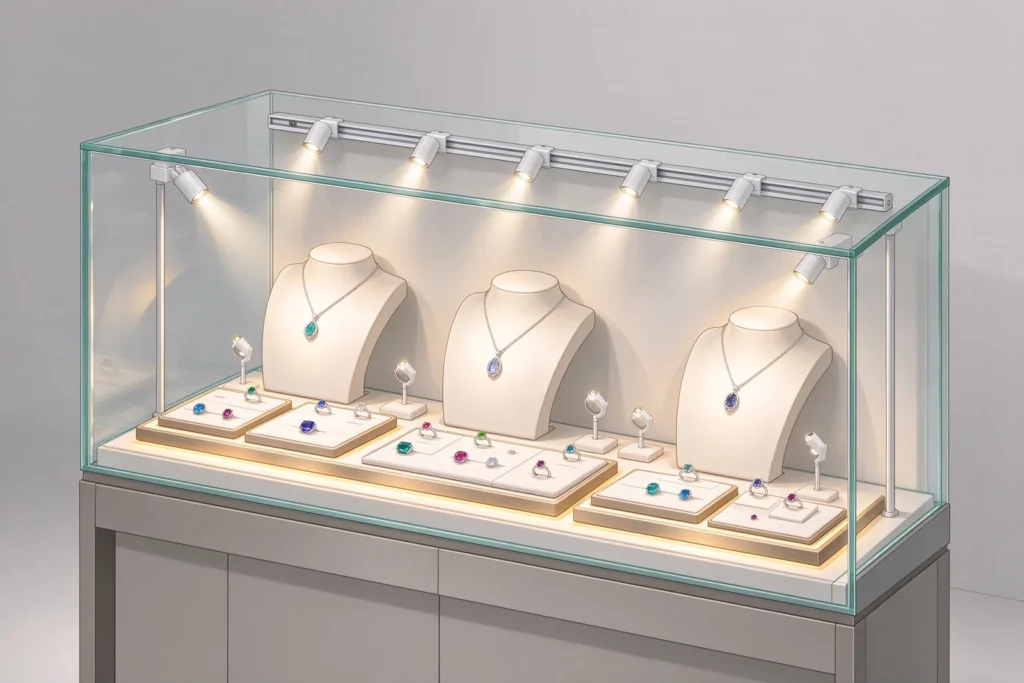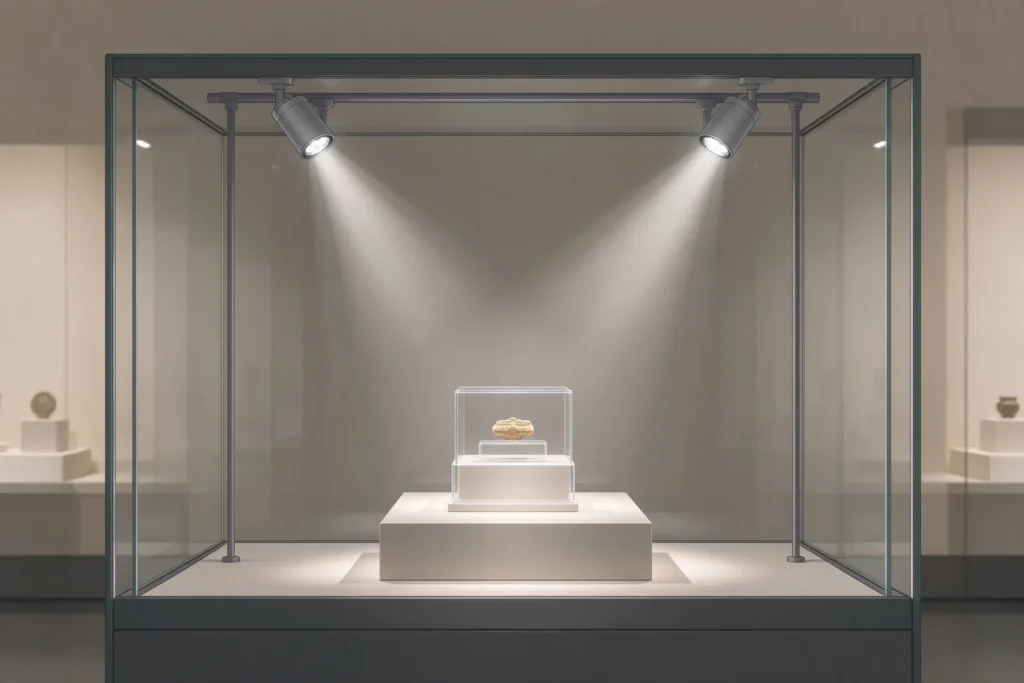
Take the same cabinet, the same heads, the same layout – and change only the color temperature. Gold looks two price grades apart. Silver either looks like platinum or like old cutlery. The question “3000K or 4000K?” is not about taste; it is about what is inside the case.
Last updated: November 2026
This guide gives you the split the trade actually uses, the physics behind it, and a counter test you can run in your own store before ordering a single head.
What color temperature actually changes
Correlated color temperature (CCT) describes where the light sits on the warm-to-cool scale: 3000K is warm white (energy concentrated toward amber and red), 4000K is neutral white
- 3000K flatters warmth. Yellow and rose gold, amber, citrine, warm woods and leather read richer; the light itself feels luxurious and “evening”.
- 4000K reads crisp and accurate. Silver, platinum, white gold, steel watch bracelets and diamonds look clean and sharp; near-colorless stones are not tinted warm.
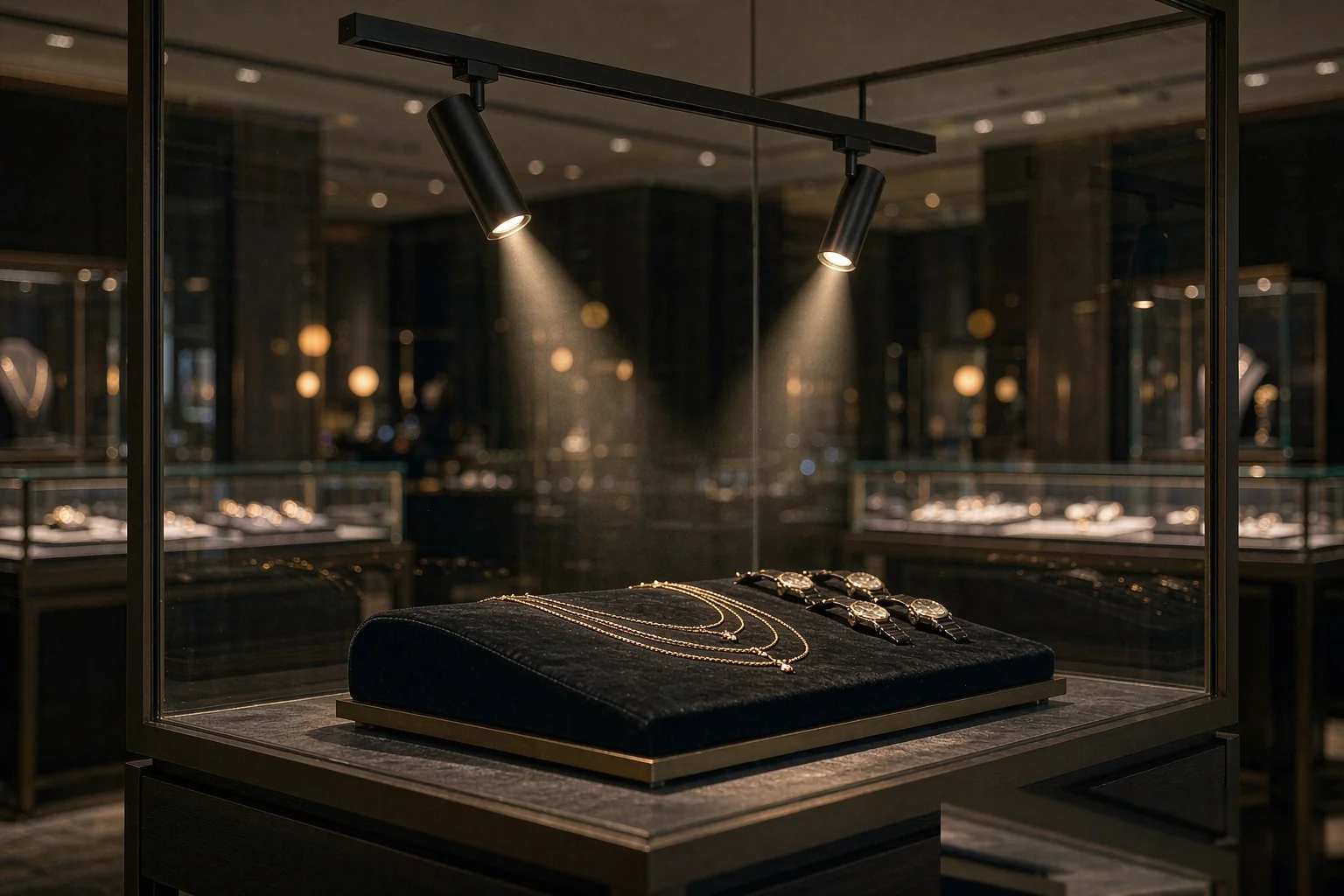
The split the trade uses
| Merchandise | Starting CCT | Why |
|---|---|---|
| Gold, rose gold, warm-toned pieces | 3000-3500K | Warm light amplifies the metal color customers are paying for |
| Diamonds, silver, platinum, steel, watches | 4000K | Crisp, neutral light keeps near-colorless stones from tinting and cool metals from yellowing; sparkle survives |
| Mixed cabinet | 3500-4000K whole-case, or split zones | Either a deliberate compromise or a warm zone and a neutral zone with a clean boundary |
| Colored gemstones | Decide by stone | CCT is secondary – color rendering (CRI, especially R9 red) decides whether the stone looks alive |
Two cautions from the same physics. Going too cool (5000K and above) makes a jewelry floor read like a laboratory – the sparkle survives but the warmth of the buying moment does not. And no color temperature rescues a poor CRI: a 4000K lamp at CRI 80 renders silver as gray. Color accuracy comes first – our high-CRI explainer covers why CRI 90+ is the floor for fine merchandise.
The counter test: decide in your store, not in a catalog
Every jewelry floor has different daylight, different surrounding finishes and different merchandise. The honest way to choose between 3000K and 4000K is to run the comparison in place:
- Get two matched sample heads – same model and wattage, one in 3000K, one in 4000K.
- Mount them in the same positions in the target cabinet, and swap positions halfway through the test so placement is not the variable.
- View from the customer’s standing position, at midday and in the evening, with the merchandise you actually sell in the case.
- Ask the sales staff which case they would rather sell from – they watch customers lean in, and they know.
We ship matched sample heads so buyers can run exactly this test in their own store – that is a fairer comparison than any photo, including ours. (We are also preparing a same-head, same-cabinet photo series in both color temperatures; ask our team for the current sample availability when you write.)

Brightness, contrast and the room around the case
A showcase does not sell by being bright – it sells by being brighter and higher-contrast than its surroundings. The surrounding store lighting sets the baseline, and the case pulls the eye. That is also why the answer to “which is brighter, 3000K or 4000K?” is misleading: at the same wattage the lumen output is similar, and perceived brightness comes from contrast and sparkle, not from the temperature. If you need more light in the case, add or re-aim heads – our lumen planning guide shows the method with real numbers.
Practical selection checklist
- Inventory your merchandise mix before specifying CCT – the mix decides, not the trend.
- Use one CCT per visual zone; make boundaries deliberate.
- CRI 90+ first, CCT second.
- Run the counter test with matched sample heads before the bulk order.
- Keep the surrounding store lighting in mind: the case must win the contrast, not fight daylight.
Frequently asked questions
Can I mix 3000K and 4000K heads in one display case?
Yes – and in mixed-merchandise cabinets it is often the right call. The professional approach is to split by zone: warm light over gold and warm-toned pieces, neutral light over silver, platinum and watches, with a deliberate boundary so the transition reads as design intent rather than inconsistency. A whole-cabinet compromise of 3500-4000K is the alternative when zones are not possible.
Does 4000K light make a case look brighter than 3000K at the same wattage?
Lumen output at the same wattage is similar – the difference is in how the light reads. Neutral white keeps cool metals crisp and renders near-colorless stones without a warm tint, so the case reads sharper and “cleaner” to many viewers. Perceived brightness in a jewelry case comes mostly from contrast and sparkle, not from the color temperature itself.
What about tunable-white heads?
Tunable-white LED heads let one fixture shift color temperature on demand – useful when merchandising changes seasonally or a case alternates between gold and silver collections. They cost more per head and add a control layer, so for a stable merchandise mix, fixed-CCT heads in the right temperature are the simpler and usually better choice.
Run the test with our sample heads
Tell us your merchandise mix and cabinet layout, and we will send matched sample heads in both color temperatures plus a suggested zone plan – so the 3000K vs 4000K decision gets made in your store, under your light. Start from the display case lighting guide for the full planning library, or contact us directly.