Last updated: November 2026
An eyewear store sells color and shape at arm’s length. Acetate frames in tortoise, rose and crystal; gradient-mirrored sunglass lenses; thin titanium wireframes that all but disappear under the wrong light. The customer picks a frame off the wall, walks two steps to a mirror and decides whether to buy – under your lighting. Eyewear display case lighting is therefore two lighting problems in one: light the frames on the wall honestly, and light the customer’s face at the mirror flatteringly, without letting either fight the other.
This guide covers the specification decisions for optical shops and sunglass stores, layout patterns for wall boards, counter vitrines and windows, and the product picks we actually ship for eyewear projects. Every model is a real product we manufacture, with its published figures.
What makes eyewear different from other retail displays
- Acetate and painted finishes are color merchandise. Tortoiseshell and crystal acetates shift visibly between CRI 80 and CRI 90 light. Customers choose frames by exact tone; a CRI 80 shelf makes half your color range look the same.
- Lens tints must read honestly. A mirrored or gradient sunglass lens that looks grey under low-CRI light and blue-green under CRI 90+ generates returns. What the customer sees on the shelf must match what they see outside.
- The try-on mirror is part of the display. Frames are judged on a face. If the mirror area is lit with a different color temperature or CRI than the wall, the frame “changes color” between shelf and face – and conversion drops.
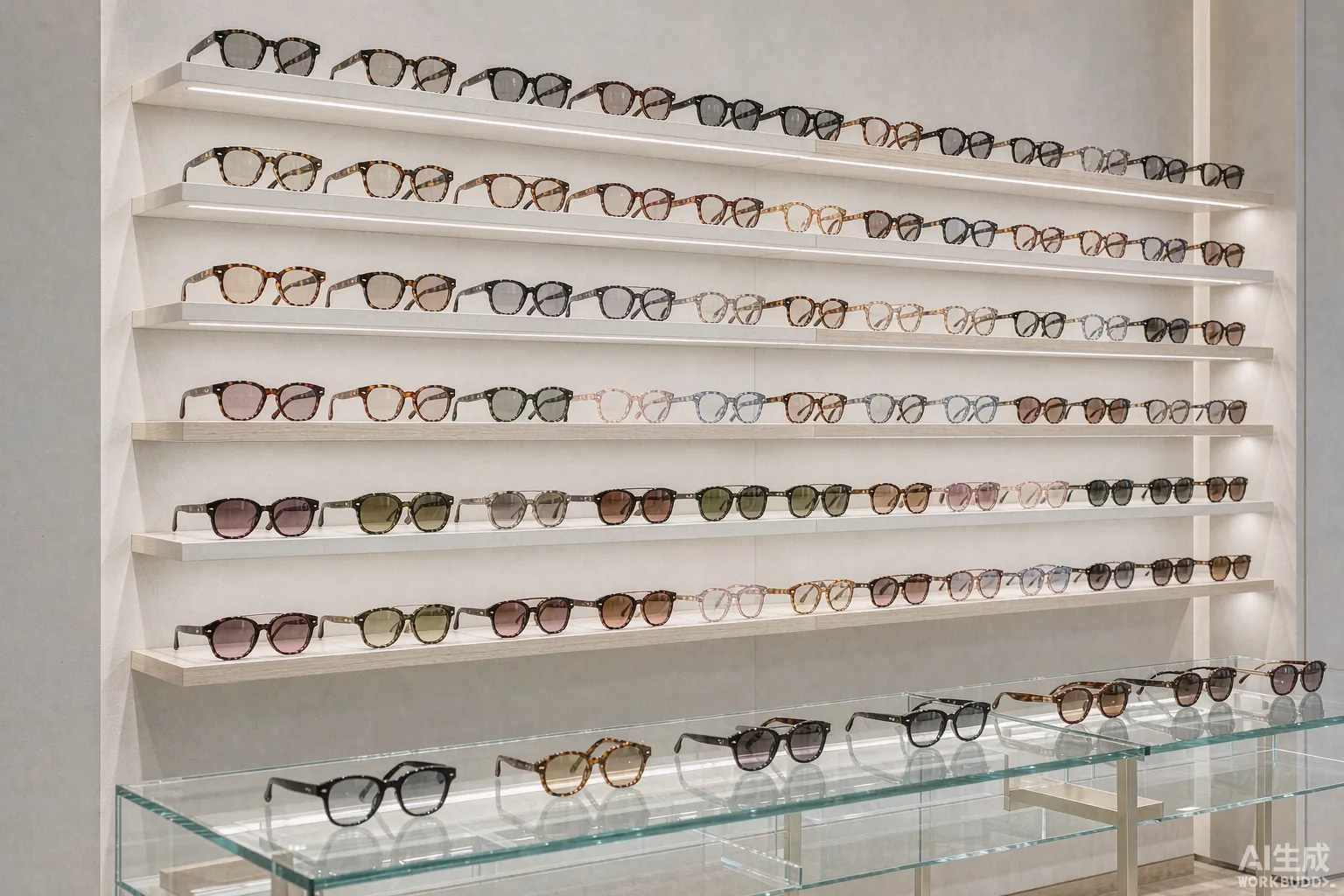
- Dense, small merchandise. A wall board carries 100+ frames on 6-10 shelf rows. Uniform, row-by-row lighting beats a few bright spots; per-frame spotlights are neither practical nor necessary at this density.
The specification decisions
Color temperature: 4000K is the eyewear default
Modern optical retail overwhelmingly runs neutral – 4000K reads clean and clinical-trendy, matches white store interiors, and renders steel and titanium honestly. Warm 3000K works when the store leans boutique or vintage with wood interiors and horn/tortoise merchandise. Our full CCT reasoning is in 3000K vs 4000K for display lighting – the same trade-off logic, applied to frames instead of rings.
Color rendering: CRI 90 across the whole store
Not just on the display wall – at the mirrors too, so the frame’s color doesn’t change between shelf and face. All OSRAM-chipped heads and our light bars publish Ra ≥ 90.
Uniformity over intensity
An eyewear wall is judged by its dimmest row. The classic failure: one fixture high on the wall, top shelves bright, bottom shelves in shadow, customers never crouching to the bottom two rows. The fix is per-row lighting – a slim bar on the underside of each shelf lip so every row is equidistant from its light source.
Glare control – for staff, not just customers
Optical staff work facing those shelves all day, often with a light bar at exactly seated eye level. Specify bars with frosted diffusers or heads with honeycomb baffles (our CHIB7528-P-3W carries an aluminum honeycomb anti-glare mesh), and angle shelf-lip bars slightly downward – 10-15° down-tilt removes the line of sight to the LED source entirely.
UV and heat for sunglasses stock
Quality LED emits negligible UV and IR, which matters for lens coatings and demo-tint stock that sits under light for years. This is the same physics we detail for museum objects in conservation lighting limits – retail scale, longer exposure.
Layout patterns by display type
The frame wall (wall board with shelf rows)
The workhorse solution: a slim LED light bar under each shelf lip, washing the row below it.
- CHIA8428-1 slim light bar – low profile, continuous even wash, lengths to fit standard board modules.
- CHIA8428-4 – the same family up to 2000 mm for full-width feature walls; length customization is available within that ceiling.
For a hero wall (designer or limited-release frames), replace the bars on one row with mini track heads – CHIB7514-P-1W (1 W, 210 lm, 15°/25°/45°) on magnetic track, one beam per frame or pair – and the premium rows visually separate from the standard wall.
Counter vitrines and glass displays
Prescription-ready premium frames and sunglasses live under glass. Small magnetic track along the case interior with CHIB7520-P-1W or CHIB7515-P-1W heads (1 W each, repositionable in seconds when the layout changes) handles most cases; our calculator turns the case dimensions into a head count and driver size automatically.
The try-on mirror area
Two rules: match the CCT and CRI of the display wall exactly, and light the face, not the mirror. Diffused warm-neutral frontal light from roughly 45° on both sides is the flattering standard; a single overhead spotlight at a mirror is the fastest way to lose a sale. Our dimming guide covers matching driver and dimmer when the mirror zone shares a circuit with displays.
The window
Sunglasses sell in the window in summer. Window lighting fights daylight, so window displays need substantially higher intensity than interior shelves, plus careful reflection control – the full method is in our applications guide.
Product picks for a typical 60-80 m² optical store
- Frame wall: CHIA8428-1 bars per shelf row, 4000K, CRI 90.
- Hero row / feature brand: CHIB7514-P-1W heads on magnetic track, 25° optics.
- Counter vitrines: CHIB7520-P-1W heads + one CHS-series driver per counter (sized with the 80% headroom rule – the calculator does the math).
- Mirror area: diffused bars or pole spotlights matched to wall CCT – our CHIA7319-3W mini pole spotlights (3 W, 210 lm, 60°, CRI 90) aim wide and soft.
All fixtures carry a 3-year warranty, MOQ is one piece, and samples ship in about three days – so you can light one wall and one mirror, check the effect on your own acetates, then roll out the full store.
FAQ
Should the whole store be one color temperature?
Yes, for the areas a frame travels through: shelf → mirror → dispensing counter. If those three zones differ in CCT, the frame visibly changes color during the try-on and customers lose confidence. Decorative accent zones elsewhere can differ.
Are light bars or spotlights better for frame walls?
Bars for dense rows (uniformity, low cost, no aiming), spotlights for hero and under-glass merchandise (control, drama). Most stores we supply use both: bars on the standard wall, heads on featured rows.
How do I stop the bottom rows looking dim?
Per-row lighting – one bar under each shelf lip – rather than a few fixtures trying to light the whole board from above. Uniformity, not wattage, is the variable that sells the bottom half of your wall.
Can I retrofit lighting to an existing store without rewiring?
Usually yes. Low-voltage magnetic track and light bars draw modest power and can often run from existing circuits; the checks are the same five we list for retrofitting existing cases.
Planning an eyewear store or a frame wall refresh? We manufacture the complete low-voltage display lighting system – bars, mini track heads, pole spotlights and drivers – and return a full fixture list with beam angles, CCT per zone and driver sizing from your store layout. Send the dimensions and a photo of the wall, and we reply within one business day.
Need this specified for a real cabinet? Tell us the case dimensions, what you display and your target market — we come back with beam angles, wattage and a fixture list.
WhatsApp this questionEmail insteadSize it with the calculator
MOQ 1 pc · samples in about 3 days · 3-year warranty on fixtures and drivers · reply within one business day (Mon–Sat, GMT+8)