The 28th Hong Kong International Lighting Fair (Autumn Edition) closed on 30 October 2026. Roughly 3,000 exhibitors from more than 20 countries packed the Hong Kong Convention and Exhibition Centre for four days, under a theme the organiser summed up as Beyond Illumination — smart connectivity, healthy living, immersive spatial experience and sustainability.
Most show reports will list the booths. This one is narrower: what the fair said about the small fixtures that go inside a display case, and what a buyer or a lighting designer should do differently because of it.


Signal one: museum credits became the credibility test
The Hall of Aurora gathered around 500 brands, and the exhibitors the organiser chose to highlight had one thing in common — a named building. Prosperity Lamps & Components was introduced through the FIFA World Cup stadium and the Museum of the Future in Dubai. Profiled Group through Casa Batlló in Barcelona and the Guggenheim in Bilbao. Dimon, in the Hall of Connected Lighting, through its work on the Hong Kong Palace Museum.
Ten years ago a supplier profile led with wattage and certifications. This year the lede was a project. That shift matters for anyone specifying showcase lighting, because it moves the conversation from “what does this fixture do on paper” to “where has it been installed, and what did it look like when it was switched on.”
Practical consequence: when you shortlist a display lighting supplier now, ask for a project reference in the same category as yours — a museum vitrine, a jewellery counter, an eyewear wall. A stadium floodlight and a 1W accent spot share a supply chain, not a design problem.
Signal two: glare is now a number, not an adjective
The most useful technical detail in the press material was not a lumen count. It was Finnish exhibitor Ledil’s STRADA reflector, described with a glare rating of G6, a threshold increment (TI) as low as 1%, and roughly 90% optical efficiency even with protective glass over it. Zhongshan SUFN’s REIZ II made a similar move from the other direction: UGR ≤ 6, convection cooling efficiency up around 15%, light output up around 30%.
For general lighting that is engineering detail. For display case lighting it is close to the whole job. In a glass cabinet, what a visitor notices first is not how much light lands on the merchandise — it is the bright blob reflecting off the front pane, or the flare on a polished watch bezel. That blob is quantified by UGR and TI. A supplier who cannot give you a glare number is telling you they have not measured it.
What we would put in a specification for a jewellery vitrine now: UGR below 10 at the viewing angle you expect, a beam angle narrow enough that the cone stops at the tray edge, and a CRI high enough that a ruby and a garnet do not read as the same red. None of those are new requirements. What is new is that the fair has made them quotable numbers rather than opinions you argue about in a meeting.
Signal three: the cabinet is turning into a screen
The fair launched a new LED Display Solution Zone this year — high-resolution LED screens, transparent displays, flexible panels, built around retail spaces, events, smart cities and architectural projects. A transparent LED film can now sit inside a glass showcase and emit its own image.
This is the change with the longest reach, and it splits the display lighting market in two. One half still needs a fixture that disappears into the cabinet and makes the product look right. The other half now needs the cabinet to be a light source, and then needs the accent lighting to work around a background that is no longer neutral.
If a project is heading in that direction, the lighting plan has to change earlier than most people expect. A transparent display panel inside a vitrine reflects just as readily as glass, and a 3W spot aimed at it will produce exactly the glare you were trying to remove. Sequence matters: decide the display surface first, then place the accents and choose the beam.
Signal four: circularity finally has a room
For the first time the fair partnered with Women in Lighting on a session titled Circularity in Lighting Design. Sustainability has been a fixture at these fairs for years, but usually as a photovoltaic or energy-storage conversation on the outdoor side. Putting it inside design practice, alongside the Connected Lighting Forum on healing light and the Innovative Lighting Design Forum on lighting beyond exhibitions, is a quieter but more consequential move.
In a display case, circularity translates into something very unsentimental: can the driver be replaced without cutting the cabinet open? Is the head a standard module, or is it glued into a bespoke housing that becomes waste the moment the client repaints the shop? We have been on the wrong side of that question as buyers ourselves. The honest answer for a 1W–3W accent spot is that replaceable drivers and modular heads cost a little more at the counter and a great deal less over a five-year fit-out cycle.
The organiser also put two numbers on the table. Fortune Business Insights projects the global lighting fixtures market growing from USD 142.52 billion in 2026 to USD 221.39 billion by 2034, a CAGR of 5.7%. GEP Research expects the photovoltaic lighting market to reach USD 18.5 billion in 2026, up 14.2% year on year. Neither figure is about showcases specifically, but both describe a market that is expanding rather than consolidating — which usually means more suppliers entering, and more claims to verify.

What a buyer should ask differently after this fair
| Instead of asking | Ask | Why it changed |
|---|---|---|
| “How many lumens?” | “What is the UGR at 30°, and the TI on a glass front?” | The fair put glare on the record as a measurable value |
| “What CRI?” | “Show me a ruby and a garnet under it, on video” | CRI alone does not settle how stones read |
| “Have you supplied big brands?” | “Which showcase project can I call?” | Museum and flagship credits are now the entry ticket |
| “Is it dimmable?” | “Can the driver be swapped without removing the head?” | Circularity moved from marketing to maintenance |
| “What is the price per unit?” | “What does the five-year replacement cost look like?” | Fit-out cycles, not unit price, decide the budget |
Where our own range sits in this
We make miniature accent fixtures for display cases, in three families that map onto the signals above.
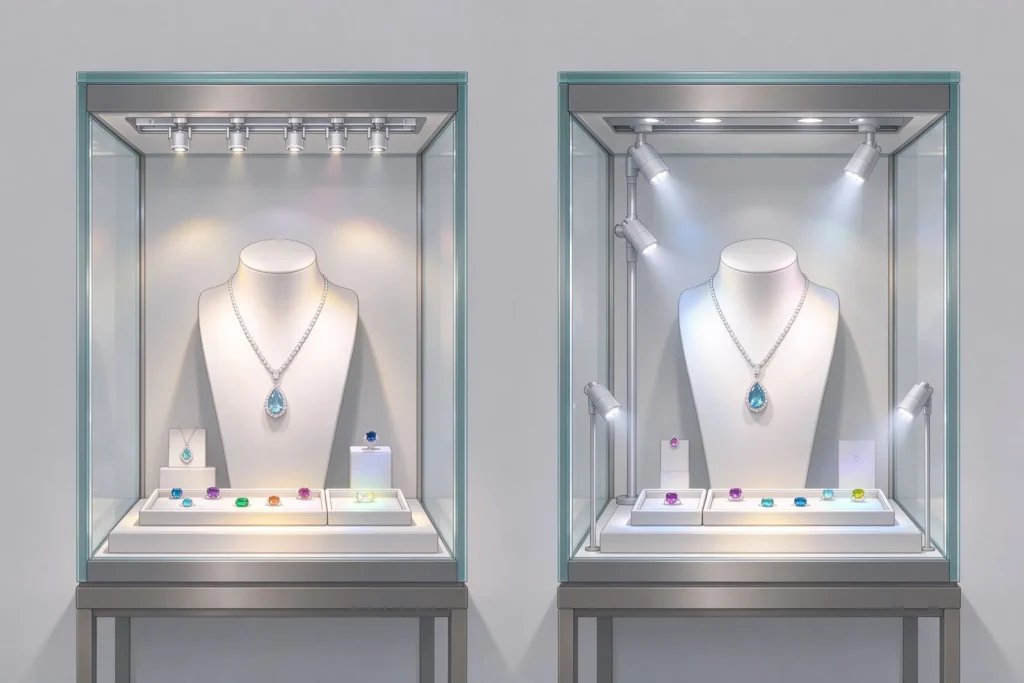
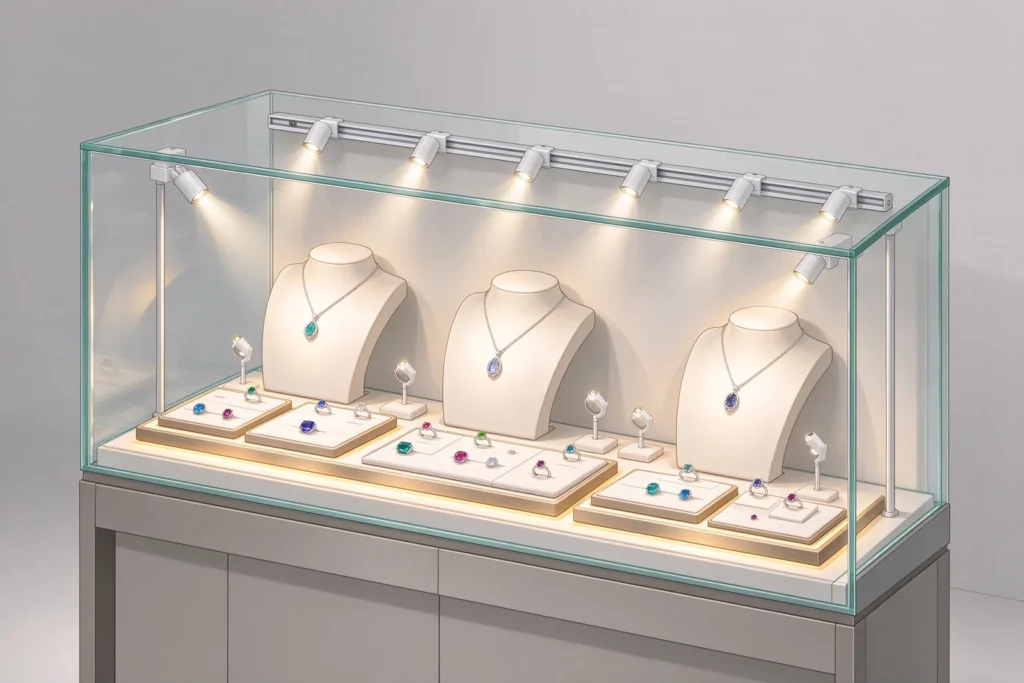
Magnetic track spots. The CHIB7528-P-3W 3W magnetic track spotlight and the 1W members of the same series are the workhorses for jewellery and eyewear vitrines — a slim rail, heads you slide and re-aim as the display changes. The magnetic track lighting range covers single, twin-head and zoom variants. If you are deciding between this and a fixed pole fixture, we set out the trade-offs in magnetic track versus pole spotlights.
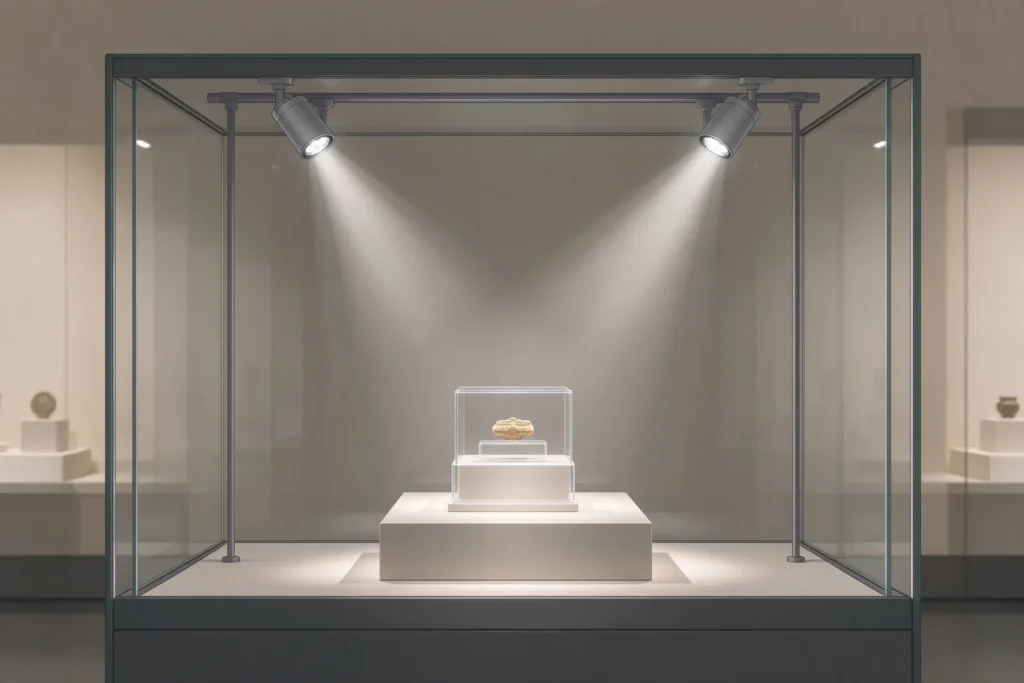
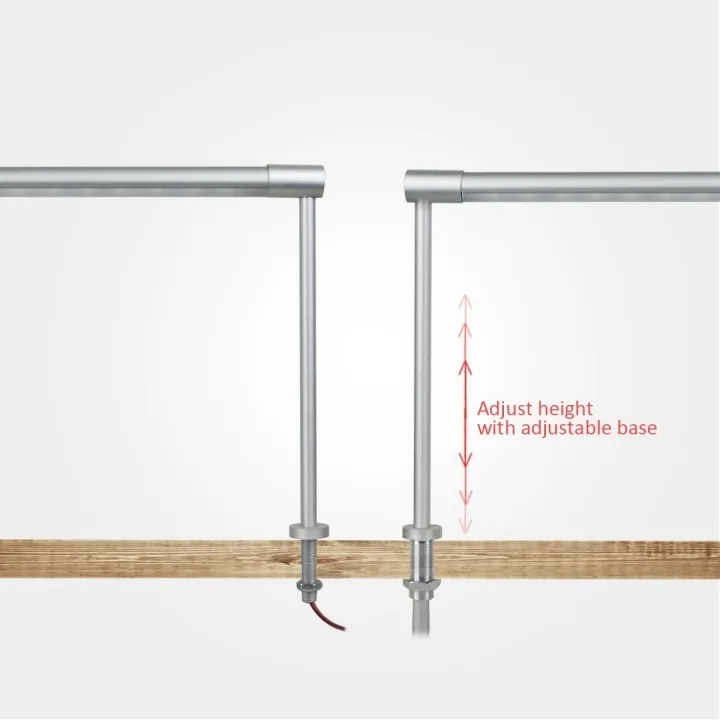
Pole spotlights. Where the cabinet cannot take a rail — a freestanding vitrine, a museum plinth — the 1W mini pole spotlight and the 3W versions put the source on a thin stem that reads as part of the case rather than equipment bolted to it. The museum exhibit lighting page covers the UV and heat side of that decision.
Linear light. For shelf edges and under-shelf washes the CHIA8428-1 slim LED light bar, including the 6mm rotatable version, handles the parts a spot cannot reach evenly.
What we do not claim: we are not going to tell you we have a CRI 97 production line or a tunable-white display series today. Those are in development, and describing them as shipping product would be the exact kind of claim this year’s fair rewarded other people for proving. What we do have is CE certification, an MOQ of one piece, and the ability to build to a drawing.
What we are watching for 2027
Three things, in order of how soon they will affect a quotation.
Glare metrics in the RFQ itself. Buyers at this fair were quoting UGR and TI in conversation. Once that reaches the enquiry form, suppliers who never measured glare will be filtered out before price is discussed.
Transparent display integration. Not a lighting problem yet for most projects, but the first flagship retail fit-outs will force a lighting plan that accounts for an emissive surface inside the case. Expect the beam angle conversation to get much narrower.
Repairability as a purchasing criterion. Replaceable drivers and standard modules will move from a nice sentence in a brochure to a line in the tender. That is good news for anyone specifying 200 cabinets across a retail rollout.
If you are sourcing display lighting now
Send us the cabinet dimensions or drawings, the merchandise type, how often the display changes and the quantities you have in mind. We will come back with a fixture selection and a beam plan rather than a price list.
Two pages answer the questions that usually come next: OEM and custom manufacturing explains what can be changed — housing colour, length, CCT, connector layout — and MOQ, lead time and sample policy covers the commercial side: one piece minimum, samples in about three days for standard items, roughly one week for custom housing colours.
If you are earlier in the process, the jewelry display lighting and museum exhibit lighting pages set out the specification method with worked examples, and our guide to LED lighting in museum display cases goes deeper on heat and UV. Ready to talk? Send the drawings through the RFQ form.