Last updated: November 2026
A collectible’s value is condition – and light touches both halves of that. It is the only thing standing between a shelf of painted PVC and a dim box where nobody sees the paintwork; it is also, run badly, one of the things that ages paint, yellows resin and cooks adhesives over the years. Jewelry lighting optimizes for sparkle. Collectible lighting has to do the opposite job: render matte painted surfaces honestly, without glare, without heat, and without fading what you paid for.
This guide covers the six specification decisions that matter for figure, statue and sneaker cabinets, layout patterns by case type, and the failure modes collectors complain about most. Every product mentioned is a real model we manufacture, with its published figures.
Why collectibles are a different lighting job from jewelry
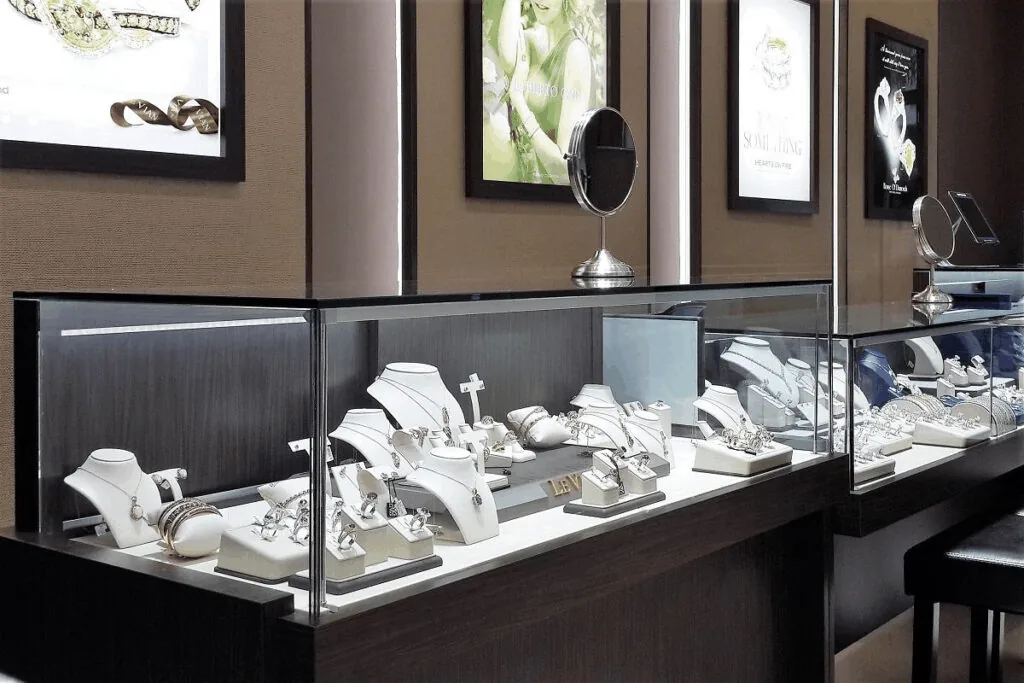
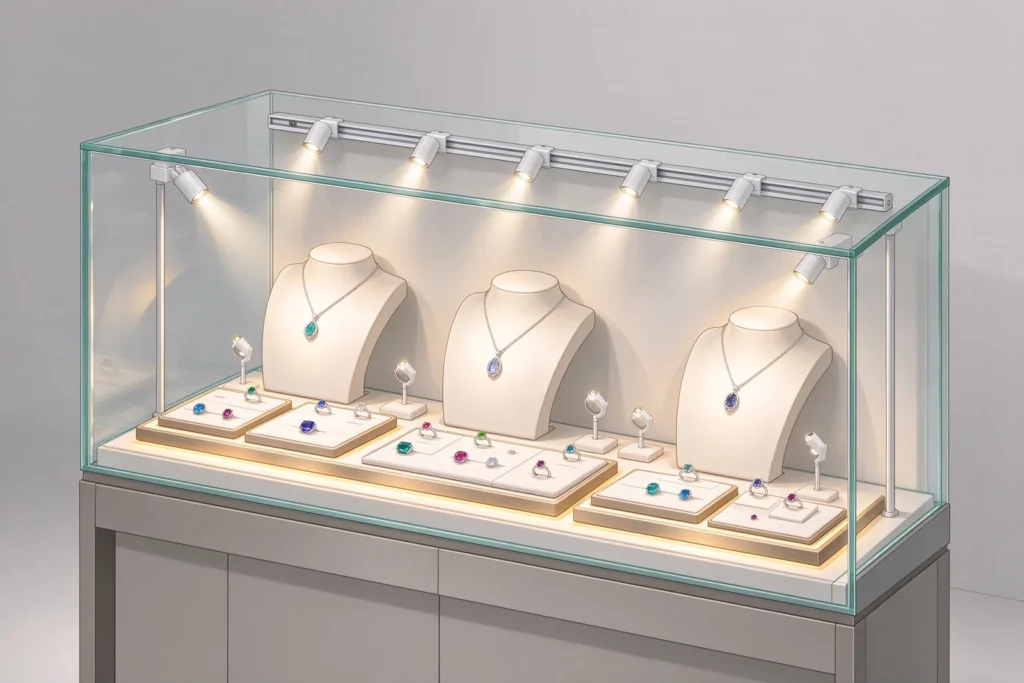
Jewelry is cut stone and polished metal: it lives on concentrated high-intensity light that creates sparkle. Collectibles are the reverse:
- Matte painted surfaces – PVC, ABS, polystone and painted resin absorb light instead of returning it, so they need even, color-accurate illumination rather than a blinding point source.
- Fade sensitivity – paint pigments, decals and fabric accessories are the parts of a figure most vulnerable to long light exposure and heat. A jewelry setting never worries about this; a collectible cabinet should.
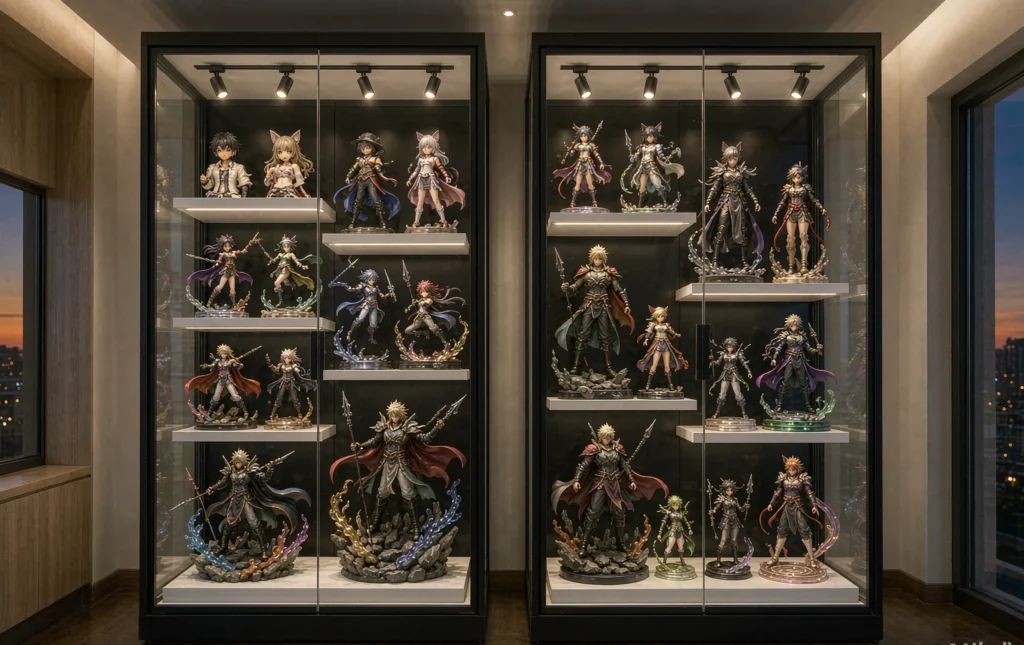
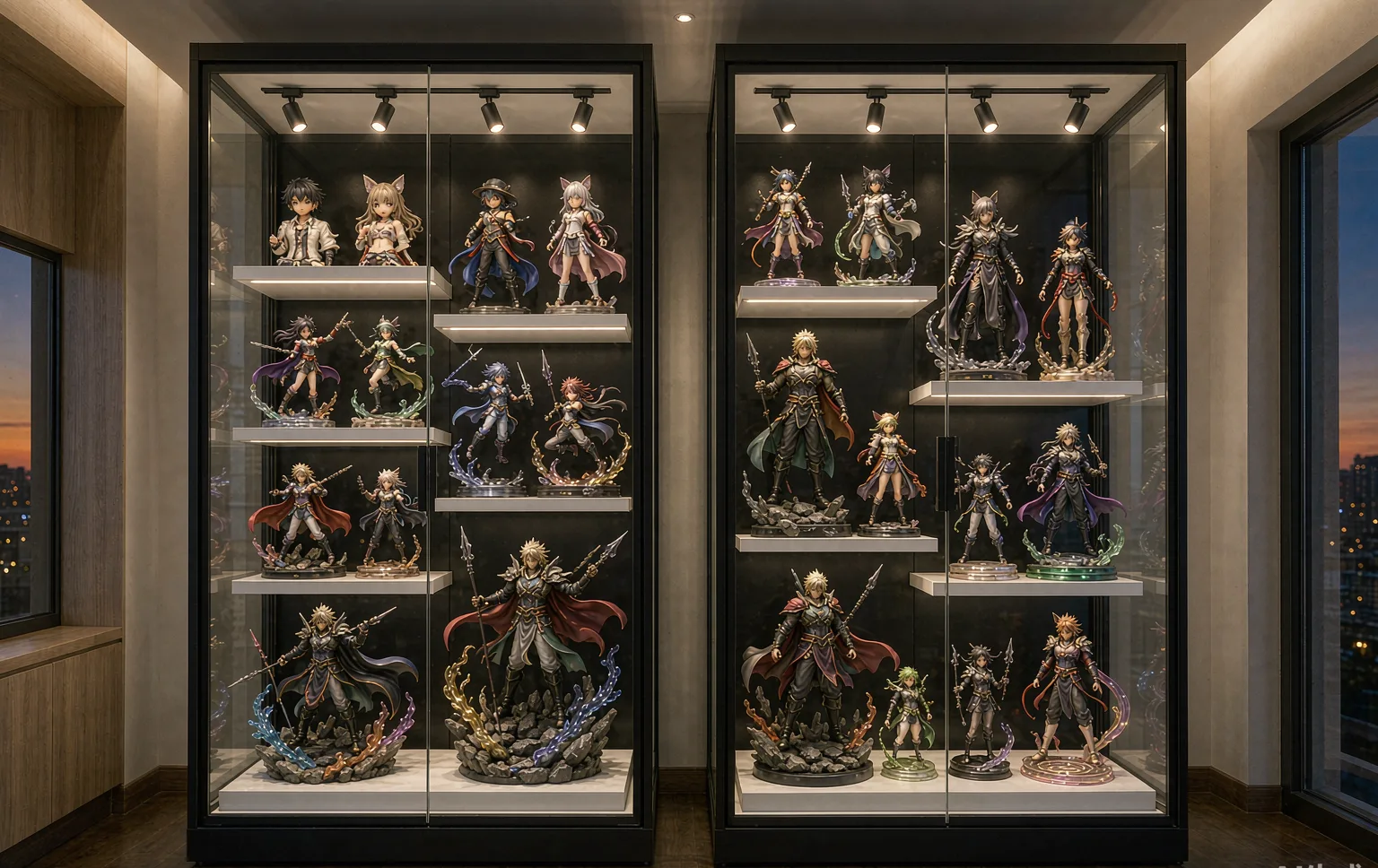
- Tall, multi-tier cases – most collectors display in towers with four to six shelves, each needing its own light, not one floodlight from the top shelf drowning everything below.
- Mixed merchandise – the same cabinet often holds figures, diecast models, sneakers and boxed items with wildly different optimal light.
Get these four right and the specification almost writes itself.
Six specification decisions
1. Color rendering: CRI 90 is the floor, not a bonus
Collectible paintwork is judged under your light. At CRI 80, warm paint hues shift subtly but visibly – the exact reason jewelry buyers pay for 90+. We build every head on OSRAM COB chips at CRI 90 as standard (90+ in practice), because at collector-display distances of 30-60 cm, color error is not a spec-sheet abstraction – it is the difference between a paint scheme looking intentional and looking off.
2. Color temperature: 3000 K or 4000 K, rarely 6000 K
3000 K (warm white) suits warm-toned paint, skin tones, wood shelves and resin bases. 4000 K (neutral) suits white armor, silver, grey, and tech/mecha styling – and is the safer single choice for mixed cabinets. 6000 K reads clinical, shifts warm hues grey, and belongs in inspection stations, not display shelves. The trade-offs are laid out in our 3000 K vs 4000 K comparison – the logic transfers directly from jewelry to collectibles.
3. Beam angle and throw distance
The head sits 30-60 cm above the merchandise in a typical cabinet – distances where beam choice decides everything:
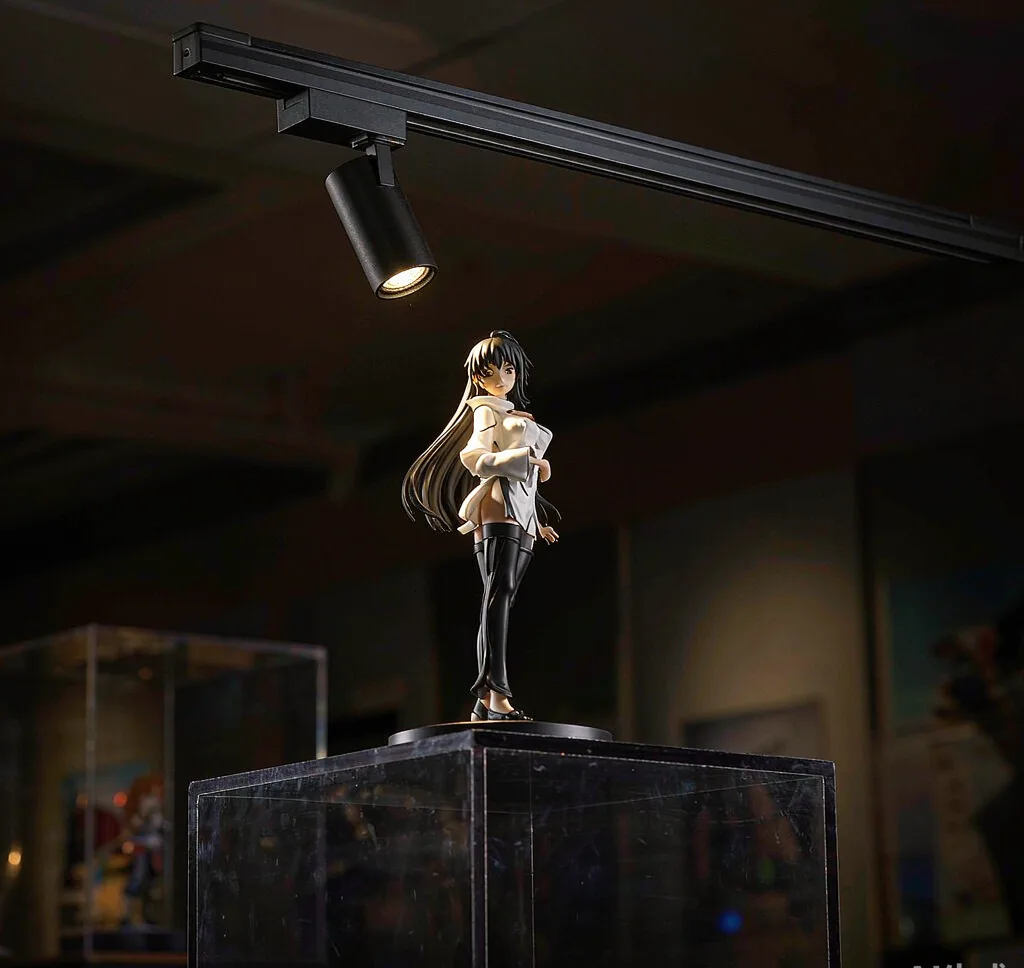
- 15° – a single hero figure. Tight pool, maximum presence, dramatic falloff.
- 25° – a pair or a small group on one shelf.
- 45° – a full shelf run of smaller items, or lighting a back panel to lift the whole tier.
- 10°-60° zoomable – mixed cabinets that change with the collection. Our CHIB7523-P-3W covers the whole range with a twist of the head, which is why it is the default recommendation for collectors who rearrange often.
4. Illuminance and exposure: bright enough to read, dim enough to last
As a starting point – a practice range, not a conservation standard – 150-300 lux on the merchandise renders paintwork fully while keeping light dose low. Three habits matter more than chasing exact numbers:
- Put the cabinet lighting on a timer or dimmer – a figure lit 12 hours a day receives twice the dose of one lit 6. Our dimming guide covers control options that do not require an app.
- Keep the case out of direct sunlight – daylight is the dominant fade source in real rooms, LED cabin lights are a rounding error next to it.
- For museum-grade or irreplaceable pieces, apply conservation limits properly – our lux limits and UV safety guide carries the museum numbers.
5. UV and heat: the LED advantage, stated honestly
Quality white LEDs emit negligible UV and run cool – a 3 W LED head replaces a 50 W halogen, cutting both heat load and light dose dramatically. That is the whole reason the old advice “keep collectibles out of light” no longer conflicts with “keep collectibles visible”: inside a cabinet, a low-power LED system is about the gentlest light a collectible can receive. What still matters is what surrounds it – sunlight through a window, and heat buildup from oversized fixtures in sealed cabinets.
6. Glare and reflections: aim at the figure, not the glass
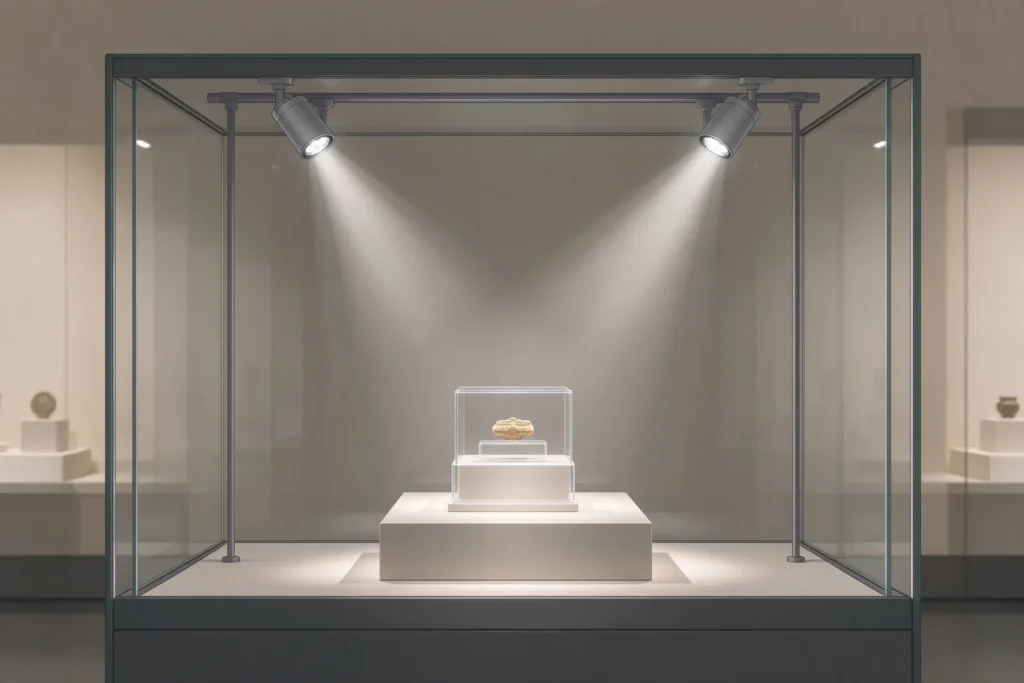
The classic multi-tier failure: a bright head low on the shelf throws its reflection straight into the front glass, and every tier above shows a mirrored spotlight. The fix is geometry, not equipment: mount heads at the front top edge of each shelf or cabinet ceiling, aim 30-45 degrees down at the merchandise, and keep the head aperture tilted away from the sightline. A matte dark cabinet interior kills secondary reflections; and dimming the case slightly below room ambient at night turns the glass invisible. More positioning patterns are in our applications guide.
Layout patterns by case type
Single-tier low cabinet (counter case)
One head per 40-60 cm of run at the front top edge, 25-45° optics, plus one 15° head per hero piece. Two heads cover a standard 100 cm counter case; three if it is deep enough for two rows.
Multi-tier tower (the collector standard)
Mount a slim magnetic track inside the cabinet ceiling and one per shelf front, or – cleaner – a single track per shelf tier with short 40-60 mm stems. One 25° head per shelf of mid-size figures, 15° per hero, 45° where the shelf holds boxed or flat items. A five-shelf tower lands at 6-9 heads: with 3 W heads that is 18-27 W total, comfortably within one 80% loaded driver.
Corner and wall-niche cabinets
Light from the front edge across the diagonal, 45° optics, and consider lighting the back panel instead of the merchandise when the niche is shallow – a lit back panel silhouettes every figure in front of it and eliminates glass reflection at the same time.
Acrylic dust boxes on open shelves
Light the shelf, not the box: hide a low head at the shelf’s front lip aimed under the box lid’s overhang, or light from the shelf above through the acrylic – clear acrylic passes light with almost no loss, and the box keeps its job as dust protection.
The failure modes collectors actually complain about
We aggregated the public review data for display case lighting recently, and the failure list applies to collector cabinets word for word: integrated cabinet lights that cannot be replaced, adhesive puck lights that fall within months, drivers dying under load, and listings that vanish so you can never extend the system. The modular response is the same: heads on an aluminum rail, external serviceable driver, reorderable by model number. The full breakdown is in Why Display Case Lights Fail: 8 Common Problems.
Two collector-specific ones to add: mixed color temperatures in one cabinet (one 4000 K head among 3000 K neighbors reads as a fault, not a feature), and no controls at all – a cabinet that runs 100% brightness around the clock ages its contents faster and costs more to run. Both are one-line fixes at specification time.
Recommended configurations (real models, published figures)
| Scenario | Head | Key figures | Why |
|---|---|---|---|
| Hero figure, 15° accent | CHIB7518-P-3W | 3 W · 150 lm · OSRAM COB · CRI 90 · 15/25/45° interchangeable optics · 12-24 V | One head, three optics – swap the lens as the collection changes |
| Mixed / evolving collection | CHIB7523-P-3W | 3 W · 210 lm · 10°-60° zoomable · CRI ≥90 · 12/24 V | Zoom covers hero accents and shelf runs without swapping parts |
| Tall cabinet wash / back-panel lift | CHIA-2404-5W | 5 W · 480 lm · 110° wide · CRI ≥90 · 12 V · Ø12 mm drill mount | Wide, bright wash for shallow niches and silhouette lighting |
Driver rule: total head wattage × 1.2, continuous load at or below 80% of the driver rating – worked examples in the driver selection guide. A five-shelf, eight-head 3 W tower needs a 30 W driver: 24 W of load, 28.8 W after the factor, one size up.
Get the numbers for your cabinet
Enter your case width, depth, height and shelf count into the showcase lighting calculator and it returns a fixture count, beam angle, total load and minimum driver rating in seconds. If you would rather have a human check it – or the case is an odd shape – send us the dimensions and the collection type, and we will reply with a complete configuration list: track, heads, driver, cords and the recommended spares package. It is free, and it comes from the factory that builds the heads.
Frequently asked questions
Do LED display case lights fade collectible figures?
Fading is driven by ultraviolet light, visible light dose and heat – and by far the biggest real-world source is daylight falling on the cabinet. Quality white LED sources emit negligible UV and run cool: a 3 W LED head replaces a 50 W halogen, which cut both heat load and light dose dramatically. The practical rules: keep the cabinet out of direct sun, use UV-filtering film on windows in bright rooms, and put the case lighting on a timer or dimmer so the figures are not lit around the clock. Our conservation lighting guide covers lux limits and exposure in detail for long-term display.
What color temperature is best for anime figures and painted statues?
3000 K (warm white) flatters warm-toned paint, skin tones, wood shelves and resin bases. 4000 K (neutral) reads cleaner on white armor, silver, grey and tech-style mecha. 6000 K makes paint look clinical and shifts warm hues grey – useful for inspection photography, not for daily display. If one cabinet holds mixed merchandise, 4000 K with CRI90+ is the safer compromise; two 3000 K and 4000 K zones on separate tracks also work.
How many lights does a collectibles display shelf need?
One narrow-beam head per hero figure, one 25-45 degree head per shelf of smaller items, roughly one head per 60-80 cm of shelf run. A four-shelf tower typically lands at 4-8 heads – about 12-24 W total, which one small 12 V/24 V driver carries with room to spare. Our showcase lighting calculator gives you a fixture count, beam angle and driver size from the cabinet dimensions in seconds.
Is 6000 K daylight white good for displaying collectibles?
For display, usually not. Cold white flattens warm paint hues and makes everything look like a retail warehouse. Where 6000 K genuinely helps: checking paint condition and taking listing photos, where neutral-to-cool light reveals defects. If you want both, use zoomable or interchangeable-optic heads on the same track and keep a separate inspection lamp.
How do I avoid glare and reflections in a glass display case?
Aim each head from just inside the front top edge at a 30-45 degree angle down at the merchandise, so the hotspot lands on the figure – not on the front glass. Keep heads tilted so their visible aperture is not mirrored in the glass, dim the case to slightly below room ambient at night, and prefer a matte black or dark grey cabinet interior: it kills secondary reflections and makes lit figures pop. Zoomable 10-60 degree optics help you tune the spot without swapping parts.
Need this specified for a real cabinet? Tell us the case dimensions, what you display and your target market — we come back with beam angles, wattage and a fixture list.
WhatsApp this questionEmail insteadSize it with the calculator
MOQ 1 pc · samples in about 3 days · 3-year warranty on fixtures and drivers · reply within one business day (Mon–Sat, GMT+8)