Last updated: November 2026
Your shop window is the only part of your store that works 24 hours a day. At noon it competes with the sun; at dusk it competes with every other glowing façade on the street; at midnight it is a billboard running on your electricity bill. Window display lighting is not “indoor display lighting, but brighter” – it is a different discipline with its own physics: daylight compensation, street-side glare, sealed-air heat, and a display that gets rebuilt every season.
This guide covers the layering method we use when lighting retail windows for jewelry, eyewear, watches and gift merchandise, the numbers to aim for, and how low-voltage magnetic track turns seasonal rebuilds from an electrician’s job into a shop assistant’s job. Every product mentioned is a real model we manufacture, with its published figures.
What a shop window must do
- Stop a walker in 2 seconds. People pass a storefront at 1-1.5 m/s. What stops them is contrast – a bright, focused pool of light on one object against a darker surround, not an evenly bright box.
- Sell one idea, not the whole range. A window that shows 30 products shows nothing. Lighting should enforce the hierarchy: one hero object at 2-3× the intensity of everything else.
- Hold up against daylight. At midday a window lit to interior levels looks like an empty glass box from the street – daylight wins and the display disappears. The window needs its own, higher target.
- Survive the rebuild. Windows change every 4-8 weeks. If re-lighting requires an electrician, the lighting will quietly stop being adjusted – and the window stops working.
The intensity numbers
Working rules we use in window projects (measured on the merchandise, at the glass):
- Daytime target: roughly 1,500-2,500 lux on the hero object. That sounds extreme next to interior retail levels (300-500 lux) – it has to, to beat incident daylight through the glass. Higher for south-facing windows, lower for shaded streets.
- Evening target: 15-30% of the daytime level. A window left at daytime intensity after dark glares off the glass and looks cold; a dimming schedule is the difference. Our dimming guide covers the driver and dimmer combinations that actually deep-dim without flicker – and flicker in a window, visible from the street, is a brand problem (see the 6-step flicker diagnosis).
- Hero-to-surround ratio: at least 2:1, ideally 3:1. If everything is bright, nothing is the hero.
The three-layer method
A window that stops traffic almost always combines three light layers:
Layer 1: Accent – the hero spots
Narrow-beam spotlights on the one or two objects that carry the campaign. This is where zoomable optics earn their keep, because window geometry changes with every rebuild:
- CHIB7523-3-3W – 3 W, 280 lm, 10°-60° zoomable, OSRAM chip, CRI 90. The same head goes from a tight 10° pool on a single ring to a 60° wash on a mannequin bust without touching a ladder twice.
- CHIB7538-P-7W – 7 W for deep windows or daytime punch where 1-3 W heads lose the fight with the sun.
Layer 2: Wash – the even base
Continuous light bars behind or above the display lift the whole window to the base level and keep secondary merchandise readable: CHIA8428-1 slim bars (up to 2000 mm in the family, length customization available). A wash layer also softens the shadows the accent layer creates – without it, windows look theatrical but harsh.
Layer 3: Backlight – the depth cue
A low-intensity bar or panel behind the display separates the merchandise from the store interior behind it, adding depth that reads from across the street. This is the layer most windows are missing, and it is cheap: one slim bar, one channel of dimming.
Glare and reflections – the street-side problem
The physics that governs reflections inside display cases (see our beam angle guide) is even harsher in a window, because the “viewer” can stand anywhere on the street:
- Never aim a spot at the glass. Angle fixtures down and inward so beams terminate on merchandise or the window floor, never on the pane.
- Baffle the sources. Bare visible LED sources in a dark street are blinding to passers-by and hide the display behind veiling glare. Honeycomb-baffled heads (like our CHIB7528-P-3W with its anti-glare mesh) keep the light where it belongs.
- Control the store behind. The single most common self-inflicted window problem: the store interior brighter than the window, so the glass becomes a mirror of your own counter. The window should be the brightest zone of the façade after dark.
Heat and the sealed box
Many windows are near-sealed boxes: sun load by day, lighting load all night. Halogen in that environment was a heat problem LED solved – but driver placement still matters. Drivers mounted inside the sealed window cavity cook; specify them remotely mounted or in ventilated housings, and size every driver to the 80% load rule (our calculator computes load and minimum driver rating from your fixture list).
Why magnetic track wins in windows
Windows are rebuilt constantly. Traditional screwed track or fixed downlights mean every seasonal change is either a ladder-and-tools job or a compromise where the new display is lit from wherever the old lights happened to be. Low-voltage magnetic track changes the economics:
- Reposition heads by hand – slide, click, aim. A window rebuild drops from half a day with an electrician to twenty minutes with a shop assistant.
- Safe at 12V/24V – low-voltage DC track is touch-safe for staff rearranging displays around it, even live.
- One system, three layers – accent heads, wash bars and backlights on the same track and drivers, so the whole window runs on one controlled load. See the configuration guide for layouts, and the full range on our magnetic track lighting page.
A worked example: the jewelry window
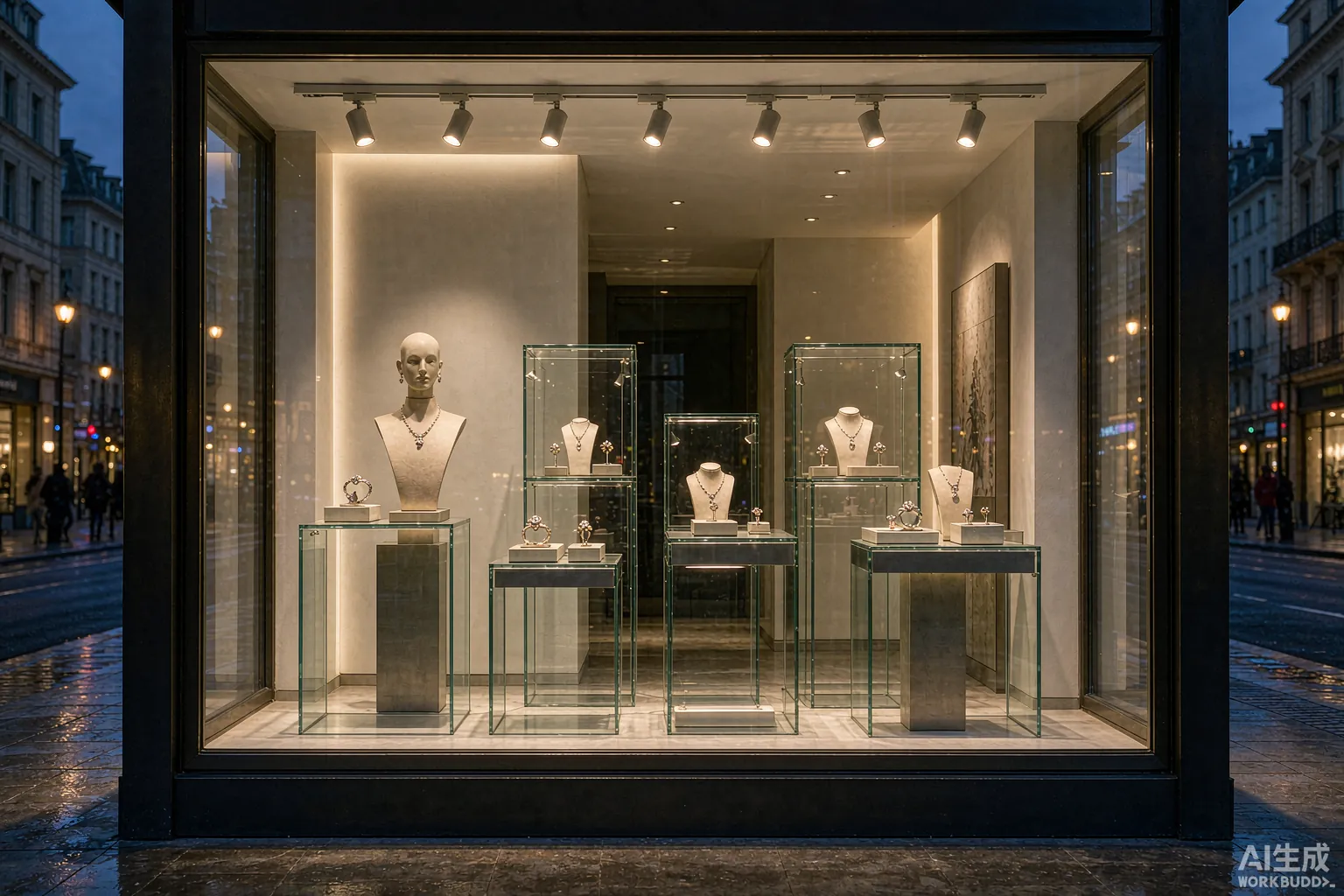
A 2.4 m × 1.2 m window, jewelry merchandise, south-facing street:
- Accents: 3× CHIB7523-3-3W zoomable heads on magnetic track across the top front edge, 10°-25° on the hero pieces, dimmed to schedule.
- Wash: 1× CHIA8428-1 bar across the top rear, lifting secondary merchandise.
- Backlight: 1× CHIA8428-1 bar low behind the display floor.
- Driver: one CHS-series unit, total load about 19 W, sized with headroom; dimmable driver on a schedule for the evening step-down.
Total electrical load is under 20 W – the running cost of the window’s 24-hour billboard job is roughly that of a small household bulb, and the merchandise color stays true because every layer is CRI 90.
FAQ
How bright should a shop window be at night?
Bright enough to be the brightest element of your façade, dim enough not to glare: typically 300-600 lux on merchandise after dark, stepping down from the daytime 1,500-2,500 lux. If the window lights the sidewalk, it is too bright; if the store behind reads brighter than the window, it is too dim.
What CRI do I need in a window?
The same 90+ you use inside – the window is where first impressions of your merchandise color form. CRI 80 LEDs make gold look greenish and ruby look muddy under exactly the high intensities windows run at.
How many fixtures for a standard 2-3 m window?
A workable starting point: 3-5 accent heads, one wash bar, one backlight bar. Enter the window dimensions and shelves in our showcase lighting calculator for a fixture count, beam selection and driver rating.
Can I light the window from the same circuit as the shop floor?
Only if the window can still dim independently – the window’s day/evening step-down is the whole point. A separate driver and dimming channel for the window is a small cost that pays back every evening.
Lighting a real window and want the layout done for you? We manufacture the complete low-voltage system – track, zoomable and fixed heads, light bars and dimmable drivers – and return a layer-by-layer window plan with fixture positions, beam angles and driver sizing from your window dimensions. Send us the size and a photo of the street side, and we reply within one business day.
Need this specified for a real cabinet? Tell us the case dimensions, what you display and your target market — we come back with beam angles, wattage and a fixture list.
WhatsApp this questionEmail insteadSize it with the calculator
MOQ 1 pc · samples in about 3 days · 3-year warranty on fixtures and drivers · reply within one business day (Mon–Sat, GMT+8)