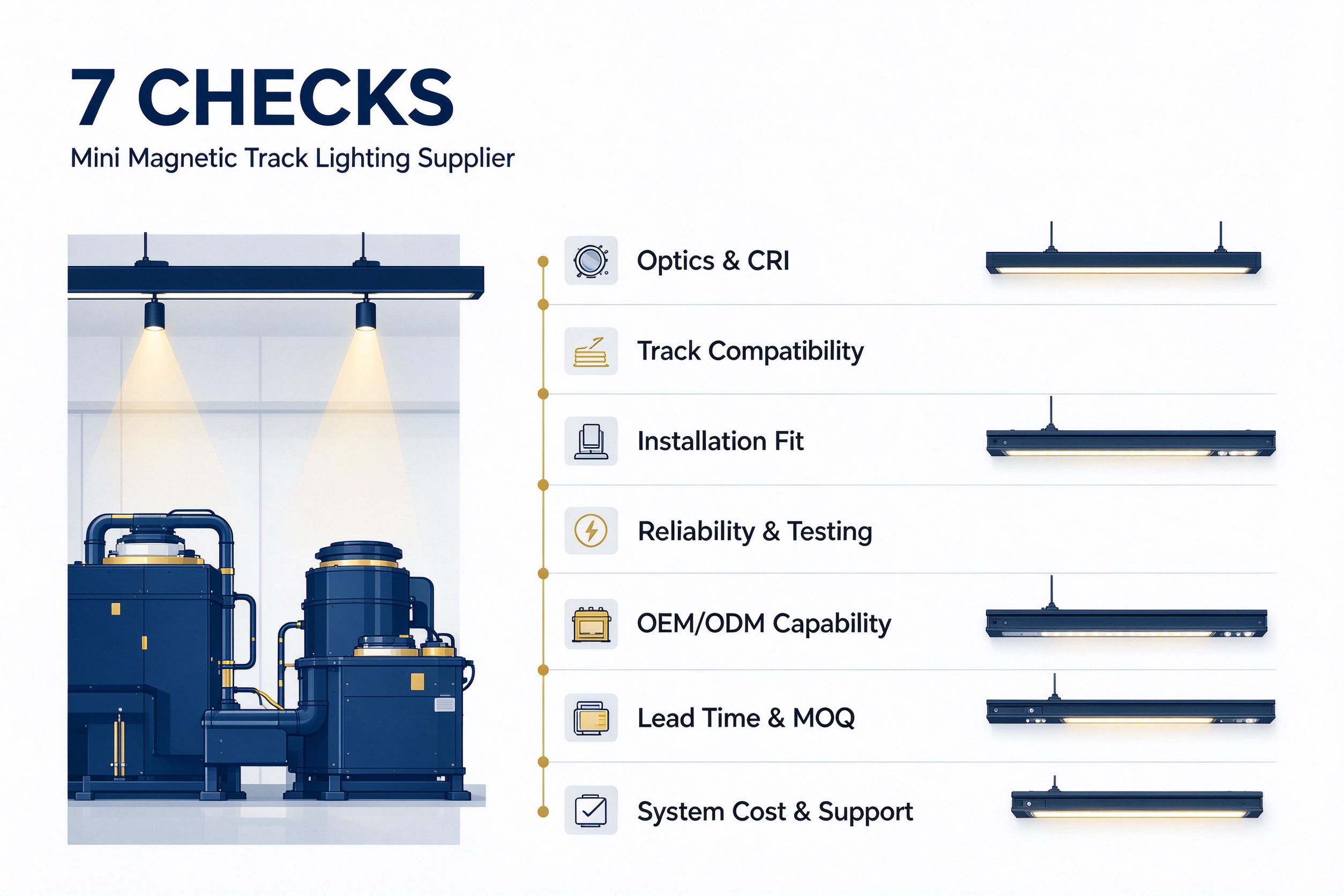
Buying mini magnetic track lighting is not a single-lamp purchase — it is a system decision. When you compare suppliers for jewelry showcase lighting, lamp price is the least reliable metric. What actually determines your cost and your customers’ satisfaction is optical quality, track and driver compatibility, installation fit, OEM flexibility, and the ability to deliver a complete, consistent system at scale. This guide gives you a practical 7-check method to evaluate a magnetic showcase lighting manufacturer before you request a quotation, order samples, or commit to a project quantity.
Key Takeaways
- Judge suppliers on the system (lamp + track + driver + connectors), not the lamp price alone.
- Verify CRI/R9, beam angle and CCT against your actual cabinet and merchandise.
- Confirm track dimensions, electrical contacts and driver voltage match your showcase structure.
- Ask for OEM/ODM evidence, lead times and MOQ before sampling, not after.
Why Supplier Selection Matters for Jewelry Showcase Lighting
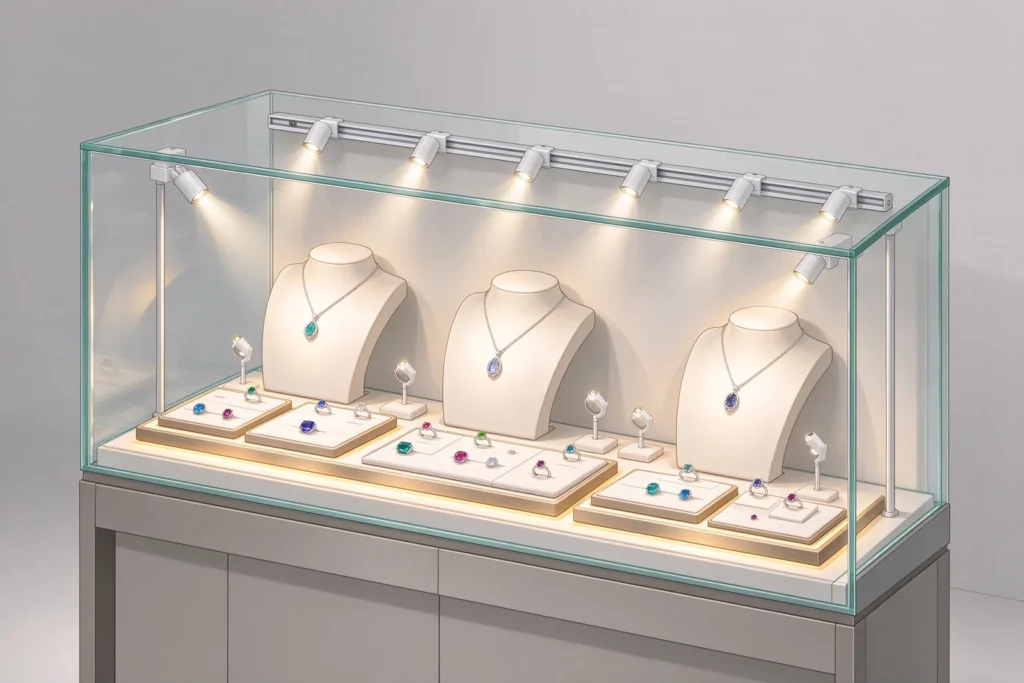
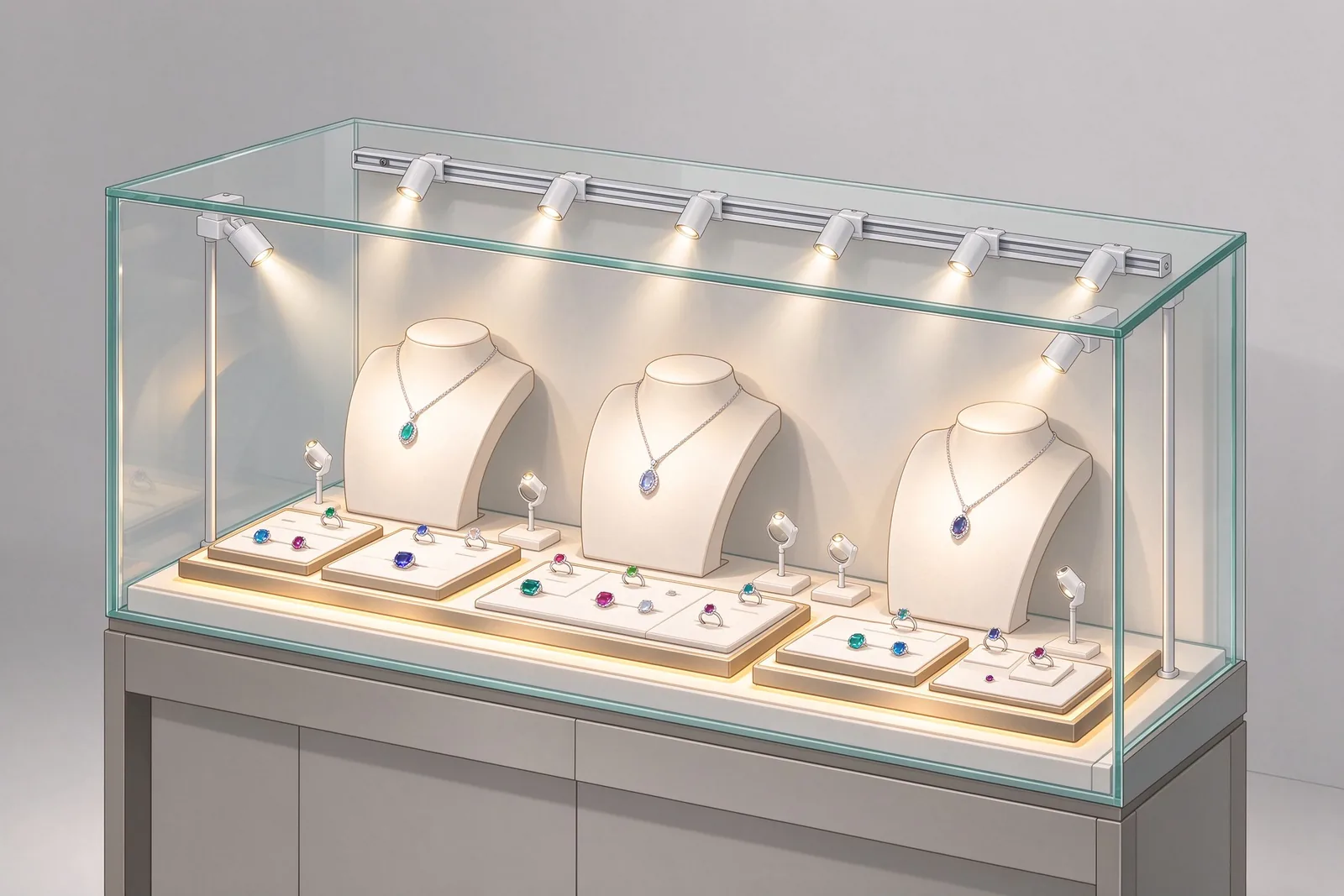
Jewelry showcases are small, enclosed spaces with reflective surfaces and a demanding colour-rendering task. A lamp that looks adequate in general lighting can wash out a diamond, dull gold, or create glare that hides the product. Because the lighting is installed inside the cabinet, replacing fixtures later is costly and disruptive. Choosing a mini magnetic track lighting supplier is therefore a long-term relationship decision: the right supplier gives you repeatable quality, compatible components and responsive technical support across many projects.
Check 1 — Optical Quality and Color Rendering
CRI, R9 and Color Temperature
For jewelry, CRI alone is not enough. Standard CRI (Ra) averages colour fidelity across a limited set of samples; R9 (deep red) matters for gold, and saturation accuracy matters for diamonds. Look for CRI Ra ≥ 90 as a baseline, published CCT options (e.g. 3000K warm white for gold, 4000K for brighter white-gold or diamond settings), and a real datasheet behind every claimed figure.
Beam Angle and Jewelry Presentation
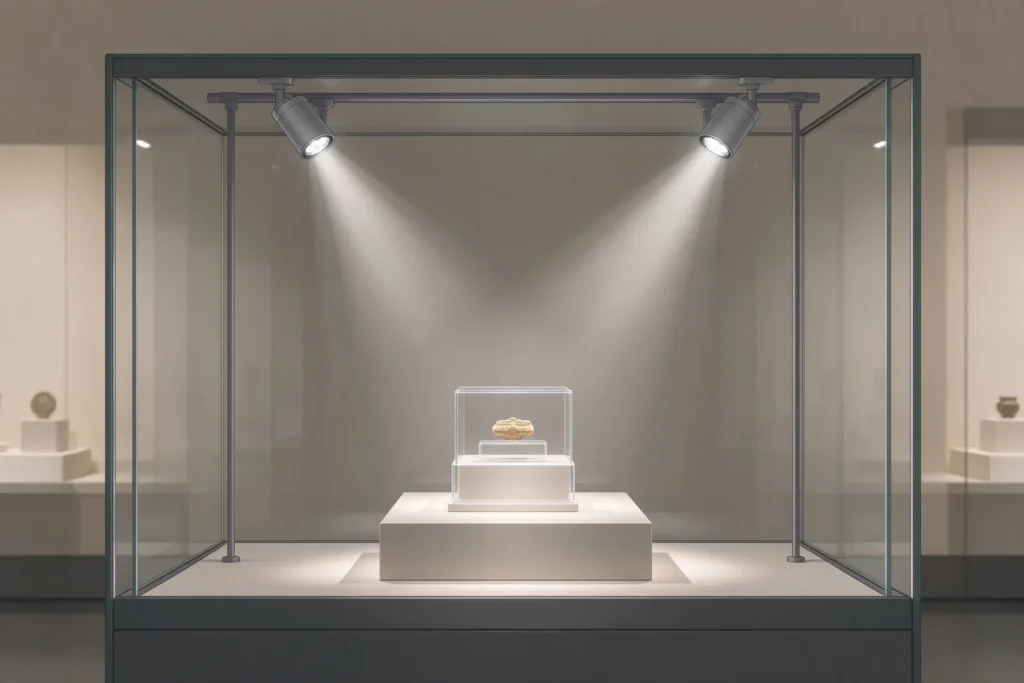
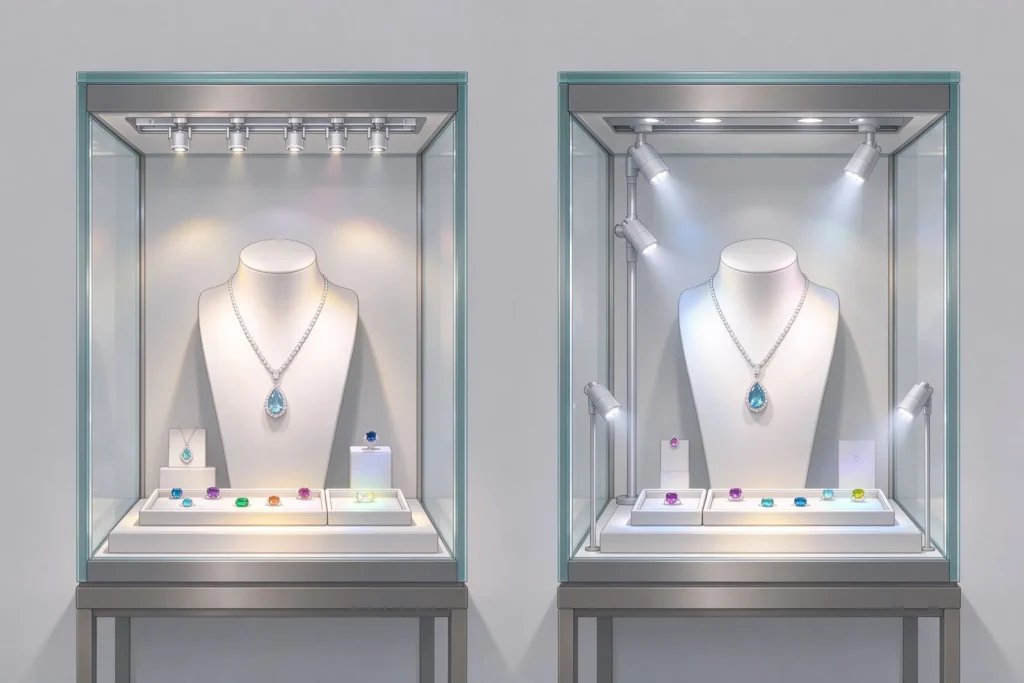
A narrow beam (15°–25°) creates a focused pool on a single tray or necklace; wider angles (45°) cover a whole tray. A quality supplier should let you choose beam angle per SKU, because a jewellery case rarely needs a single angle throughout. Ask which angles are available and how the optic is constructed (e.g. honeycomb anti-glare baffles).

Check 2 — Magnetic Track and Spotlight Compatibility
Track Dimensions and Electrical Contacts
Magnetic track systems are only interchangeable when dimensions, polarity and contact design match. Check the track profile, the magnet/contact mechanism, and whether the spotlights are guaranteed to fit the track you plan to buy. Do not assume compatibility across manufacturers. See our magnetic track lighting range.
Driver Voltage and Power Capacity
Confirm the system’s low-voltage driver (e.g. 12V or 24V) and total wattage capacity against the number of spotlights you will mount. A low-voltage system is safer to touch inside a custom cabinet, but the driver must be sized for the full load. Ask for the driver part number and its max load, and confirm connector compatibility — see our 12V/24V drivers and track connectors.
Check 3 — Installation and Showcase Integration
Glass showcases, wooden display cases and metal fixtures have different constraints — mounting points, cable routing and heat dissipation differ. A reliable supplier should explain how the track mounts in each structure, whether the driver can be hidden, and what clearance the magnetic head needs to slide and lock. Ask whether they provide installation guidance or drawings for custom cabinets.
Check 4 — Product Reliability and Quality Testing
You should be able to request genuine quality evidence: datasheets with optical, electrical and mechanical parameters; certifications relevant to your market (e.g. CE, RoHS) with the exact certificate scope; and a stated warranty with a clear after-sales policy. We do not publish test results we cannot verify, and you should ask any supplier to show the documentation behind every claimed parameter — not a logo alone.
Check 5 — OEM/ODM Customization Capability
Many jewelry showcase buyers need custom finishes, brand packaging or project-specific configuration. Evaluate whether the supplier offers housing colour/finish customization, custom packaging and brand logo, design support for beam angle/CCT/driver selection, and low-volume customisation with sample development. OEM/ODM claims should be backed by process evidence — see our jewelry display lighting solutions.
Check 6 — Lead Time, MOQ and Production Consistency
For batch buying, consistency matters as much as the first sample. Confirm the MOQ (is it truly low for regular models?), sample lead time, bulk production lead time, and how colour temperature and lumen output are controlled across production runs.
Check 7 — Complete System Cost and After-Sales Support
Compare the system cost — lamp heads + track + driver + connectors + installation overhead + maintenance — not just lamp price. A slightly cheaper lamp that requires a non-compatible track or a weaker driver can cost more overall. Also evaluate after-sales: response time, spare availability and warranty handling for a long-running project.
Supplier Evaluation Checklist
| Check | What to ask | Good signal |
|---|---|---|
| 1. Optics | CRI/R9, CCT, beam options | Ra≥90, multiple beams, datasheet-backed |
| 2. Compatibility | Track profile, contacts, driver load | Matched system, documented parts |
| 3. Installation | Mounting in glass/wood/metal | Clear guidance / drawings offered |
| 4. Reliability | Datasheet, certification, warranty | Real documents, stated warranty |
| 5. OEM/ODM | Finish, packaging, sample dev | Demonstrated capability + timeline |
| 6. Lead time/MOQ | MOQ, sample & bulk time | Low MOQ, stated, realistic |
| 7. System cost | Full system + support | Transparent quote, responsive |
Frequently Asked Questions
What is the best magnetic track lighting for jewelry showcases?
There is no single “best” — it depends on cabinet size, merchandise and beam needs. Look for Ra≥90 optics, 12V/24V low-voltage systems, and spotlights with selectable beam angles (15°–25° for focal, wider for trays).
Can magnetic track spotlights be customized?
Yes — many suppliers offer housing colour, packaging, brand logo and configuration changes. Confirm your supplier’s MOQ and sample process for custom work.
Are magnetic track systems interchangeable between manufacturers?
Not automatically. Track dimensions, electrical contacts and driver specs must match. Always verify compatibility before mixing.
What CRI is recommended for jewelry displays?
Ra≥90 as a baseline; higher fidelity (including R9) is preferred for gold and coloured stones.
What information should buyers provide for a quotation?
Cabinet dimensions or drawings, target merchandise, required quantities, preferred CCT/beam, and project region. Our RFQ form collects company, country, email, product/model, estimated quantity and project requirements.
How can buyers verify LED showcase lighting quality?
Request datasheets, certification documents and a sample; verify CRI, beam angle and lumen output against the datasheet before bulk order.
Request a Complete Showcase Lighting Quotation
Looking for a reliable mini magnetic track lighting supplier? Share your showcase dimensions, required quantities and lighting preferences to request a suitable product configuration and quotation via our contact page.