Introduction
Display lighting uses two common terms. You will hear “lighting products” and “lighting systems.” At first, they sound almost the same. A light is a light, right?
If you plan jewelry showcase lighting, museums, or high-end shops, this difference matters. It changes how everything looks. A single fixture can make something visible. A full system can make it beautiful, consistent, and easy to control across every cabinet and store.
At Chiswear, we don’t just sell fixtures. We help you design LED showcase lighting as a complete low-voltage system. It is built for your space, your brand, and your future needs.

Why Are “Lighting Products” And “Lighting Systems” So Easy To Mix Up?
Are you flipping through a catalog, seeing spotlights, bars, and tracks? It’s hard to tell where one product stops and a system starts.
You’re not alone. Many people treat these two words as one. They think they match. But here is a simple way to see it.
- A lighting product is one building block – for example, a mini spot, bar, or magnetic track head.
- A lighting system is the whole finished setup – fixtures + power + controls + wiring + mounting + design logic, all working together.
A system is like the full jewelry set: necklace, earrings, bracelet, all matching. A product is like just the ring. Both are valuable, but they do different jobs.
Quick View – Lighting Product vs Lighting System
| Aspect | Lighting Product | Lighting System |
| Scope | One fixture or module | Many fixtures plus drivers, controls, cables, mounting, and layout design |
| Role | Provides light in one spot | Shapes the whole visual experience in a cabinet, room, or store |
| Thinking | “What light do I place here?” | “How will all lights work together over time?” |
| Ownership | Often bought as a piece of hardware | Treated as a project, with planning, drawings, and clear design goals |
| Outcome | Light on an object | Controlled, safe, scalable illumination across the whole display environment |
What Is A Lighting System And How Does It Work In Real Projects?
Are you worried that “lighting system” sounds too nical or complex?
Think of a lighting system as the full story behind the light your customers see. It connects many products into one safe, organized, and controllable setup. A system usually includes:
- Multiple fixtures (spots, bars, or magnetic showcase track lighting)
- Low-voltage drivers or power supplies
- Dimming and color-temperature controls
- Cables and connectors
- Tracks, poles, or mounting accessories
- A simple wiring and zoning plan
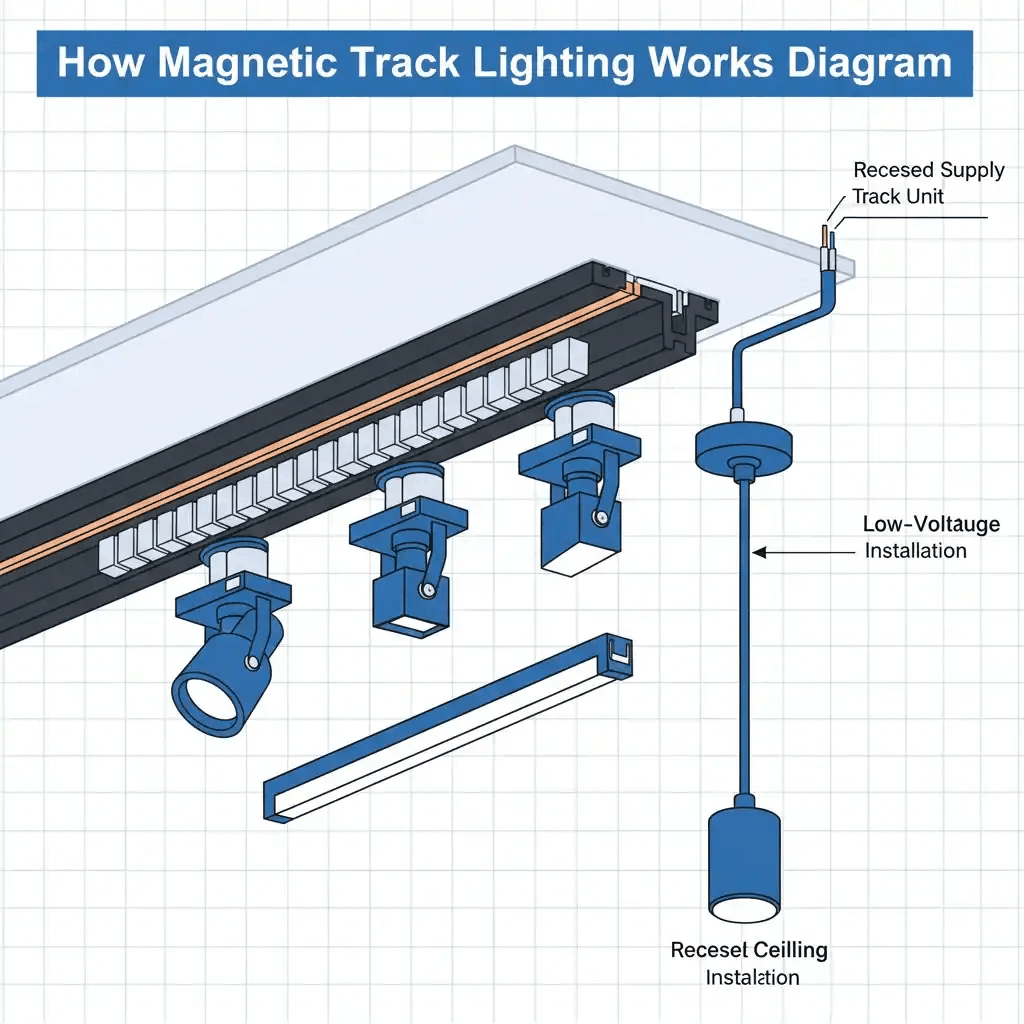
Many modern display solutions use 24 V magnetic track lighting systems. In these, LED modules snap into a powered track using magnets, making it easy to move fixtures without re-wiring.
Core Pieces Of A Display Lighting System
| System Piece | Simple Description | Why It Matters In A Cabinet Or Store |
| Fixtures | The visible lights (spots, bars, strips) | Create the actual beam and sparkle |
| Drivers / Power supplies | Convert mains power to safe low-voltage power | Protect fixtures and ensure stable light output |
| Controls (dimming, CCT) | Dials, switches, or smart modules | Adjust brightness and color temperature as displays change |
| Cables & connectors | Hidden wiring and plugs | Keep power safe, organized, and easy to service |
| Tracks / mounting | Magnetic tracks, poles, brackets | Allow flexible positioning and clean installation |
| Design logic | Zones, circuits, and scenes | Makes the system easy to use day-to-day |
When these parts are designed together, your LED showcase lighting becomes more than “lights in a box.” It becomes a planned system that you can control, extend, and maintain.
How Does Choosing A System Improve Performance, Safety, And Flexibility?
Do you fear ending up with cabinets that all look different, even though you bought “good” fixtures?
This often happens when people buy products one by one instead of planning a full system. Here’s how a system mindset changes things:
How Does A System Improve Visual Performance?
This setup keeps CRI, color tone, and beam angles the same. In all your cabinets and spaces. High Color Rendering Index (CRI) makes colors look more natural. They appear closer to how you see them in daylight.
For jewelry, this is critical. Good Jewelry display showcase lighting makes diamonds look sharp and metals look rich, rather than dull or flat. Chiswear’s guides on choosing lighting for jewelry displays show how color, brightness, and angle work together to achieve this effect.

How Does A System Add Control And Flexibility?
With a system, you can:
- Dim one zone while another stays bright
- Shift color temperature from cool (for diamonds) to warmer (for gold)
- Re-aim Mini showcase track lighting when the display layout changes
This means your lighting changes with your merchandizing, instead of fighting it.
How Does A System Improve Safety And Reliability?
A well-planned system handles:
- Correct voltage and power load for each driver
- Heat management, especially inside closed cabinets
- Clean routing of cables to avoid tangles and damage
Good thermal design keeps LED modules cooler and extends their life, which is a key point in Chiswear’s article on thermal management in LED showcase lighting.
Table 4: What Changes When You Move From Products To Systems?
| Design Area | Product-Only Approach | System-First Approach |
| Brightness | Each light adjusted on its own | Zones planned so cabinets feel even and balanced |
| Color Quality | Mixed CRI and CCT from different brands | One CRI and CCT strategy across the whole project |
| Safety | Power loads guessed per fixture | Drivers sized for total load with safety margins |
| Maintenance | Hard to trace which driver feeds which light | Clear labeling and layout drawings |
| Future Changes | New lights may not match old ones | Extra capacity built in for added fixtures and new zones |
How Does Chiswear Turn Separate Fixtures Into A Complete Lighting System?
Are you worried you’ll have to become an engineer just to get your lighting right?
You don’t have to. At Chiswear, we design systems so that your team can focus on the display, not on cables and calculations. The product range – from magnetic track light modules to mini poles and bars – is built to plug into a clear system plan.

Here’s how that usually works in practice:
How Do We Start With The Right Products?
First, we select the right mix of:
- Magnetic track heads
- Mini LED pole lighting
- Slim bars and strip modules
We match each to cabinet size, glass height, and the type of items on display. Chiswear’s analysis of lighting installation methods for jewelry and museum cases helps guide these choices.
How Do We Build The System Around Them?
Then we design:
- Power layout: Use low-voltage drivers, 12V or 24V. Keep them where cool air and access stay easy.
- Zoning: which cabinets or shelves dim together
- Control: manual dimming, preset scenes, or smart triggers
We also think about glare and reflection, using tips like those found in Chiswear’s guide on reducing glare in showcase lighting.
Table 5: From “Just Fixtures” To A Finished Chiswear System
| Step | What We Look At | Result For You |
| Assess displays | Case size, product type, glass layout | Right mix of spots, bars, and poles |
| Choose optics & CRI | Beam angle, color rendering needs | Items look sharp, colors stay true |
| Plan power & wiring | Driver wattage, cable paths, access points | Safe, neat, and serviceable setup |
| Define control zones | Which areas should dim together | Simple day-to-day operation for staff |
| Prepare drawings | Layout, labeling, connection diagrams | Clear reference for installers and maintenance |
This approach turns “a set of lights” into a working system that fits your brand and your space.
Conclusion
Still wondering what to do next for your own project?
Here’s the simple rule of thumb:
- Lighting products are the tools – spots, bars, tracks, and poles.
- Lighting systems are the strategy – how those tools work together to support your brand, your staff, and your visitors.
If you run jewelry, museum, or luxury retail spaces, it’s not enough to ask, “Which fixture looks nice?” You also need to ask, “How will all these lights work as one system?”
Chiswear helps you answer both questions. From high-quality LED showcase lighting to full plans that cover zones, power, and control, we support you from concept to installation and beyond.
External Links: