Introduction
Sustainable lighting design. When we say “reduce waste,” are we giving up quality?
In design today, sustainability isn’t an afterthought. It’s a real duty now. From buildings to display cases, lighting matters. It shapes looks, uses energy, consumes materials, and leaves lasting effects on the environment in each project, daily.
At LightrixTech, we believe this. Sustainable lighting needs no trade-offs. It means smart engineering — creating products that are efficient, repairable, and timeless, while maintaining the precision and beauty that showcase lighting demands. Let’s explore how modern lighting design can minimise waste without sacrificing performance or visual excellence.
How Can We Make Designs Last Longer?
A simple, strong way to cut waste is to make products last much longer. Rather than chase the lowest upfront price, lighting design puts durability first.
At LightrixTech, our showcase lighting — from mini tra to LED light bars — uses high-quality aluminium housings for excellent heat dissipation and corrosion resistance. This keeps the LED modules working well for tens of thousands of hours. It greatly reduces replacement needs.
Durable lights do more than save resources. They keep displays steady. Museums, shops, and galleries need stable, long-term lighting for their exhibits.
Why Is Lifespan So Important?
| Issue | Impact | Solution |
| Frequent replacements | Increased waste, higher maintenance costs, supply chain burden | Use high-quality housing, robust drivers, good thermal design |
| Heat and corrosion | Reduced lifespan of LED modules, driver failure | Aluminium housing, effective heat sink, sealed yet serviceable design |
| Visual inconsistency over time | Gallery/retail lighting is judged by appearance and colour stability | Select high CRI LEDs, stable drivers, maintainable modules |
According to industry sources, quality LED products last longer and are durable. They also give better light quality than older technology.
In display lighting, you’re lighting a high-value piece in a cabinet—jewellery, art, a heritage object. You can’t risk flicker. You can’t risk colour shifts, uneven ageing of modules, or sudden drop-outs.

How Do Efficient LEDs Give More Light While Using Less Power?
Today’s LED tech lets designers get bright, accurate colour. It also slashes energy use by a lot. We use premium LED chips from OSRAM and Bridgelux. This lets us deliver better results.
- Higher lumen output per watt (i.e., improved efficacy).
- High CRI (Colour Rendering Index) makes colours look real and consistent. Objects, fabrics, and gems show their true shade.
- Low thermal loss, extending both chip and driver lifespan.
This means clients enjoy beautiful, vibrant displays that are energy-efficient and environmentally conscious — the perfect harmony of performance and responsibility.
| Metric | Conventional lighting | Modern LED lighting |
| Energy to light conversion | Lower (large losses as heat) | Much higher. In ideal use, it turns about 80-90% of input into usable light. |
| Lifetime | Shorter lifespan, more frequent replacements | Longer life, fewer replacements needed |
| Energy consumption | Higher and less controllable | Lower, and more controllable with smart drivers and dimming |
For our product line of LED jewellery lighting and jewelry display showcase lighting, this means we can specify minimal power draw, minimal heat loading (important near sensitive gems or fabrics), and maximal visual impact. In short, lighting can be sustainable. It doesn’t need to lose quality.
Why Choose Modular and Replaceable Parts?
Waste reduction begins at the product-design stage. Instead of sealed, disposable units, our engineering philosophy emphasizes modular construction. Each part is built to swap and upgrade with ease. It’s not ever made for disposal.
When the LED reaches its end, clients can replace the light source. They don’t discard the entire fixture. This method cuts e-waste and lowers upkeep costs. It supports long-term sustainability goals for commercial and cultural institutions.
Modularity: Key Benefits
- Lower e-waste: Replace only the worn part. Not the whole unit.
- Cost-effective: Maintenance is at component level. This cuts downtime.
- Upgrade-friendly: LEDs keep getting more efficient. You can swap modules without replacing fixtures.
- Better life-cycle performance: The carbon from making it is spread out. It lasts longer.
Practical table: Modular vs Sealed Fixture
| Feature | Sealed Fixture | Modular Fixture (our approach) |
| Replacement strategy | Entire unit replaced when any part fails | Only failed component replaced |
| Maintenance cost | Higher due to full unit swap | Lower, fewer parts, less downtime |
| E-waste generation | Higher – full fixtures discarded | Lower – components discarded or recycled |
| Upgrade path | Limited | Clear upgrade path for LED modules/drivers |
| Visual consistency risk | Older units aging at different rates | Better match over time, uniform performance |
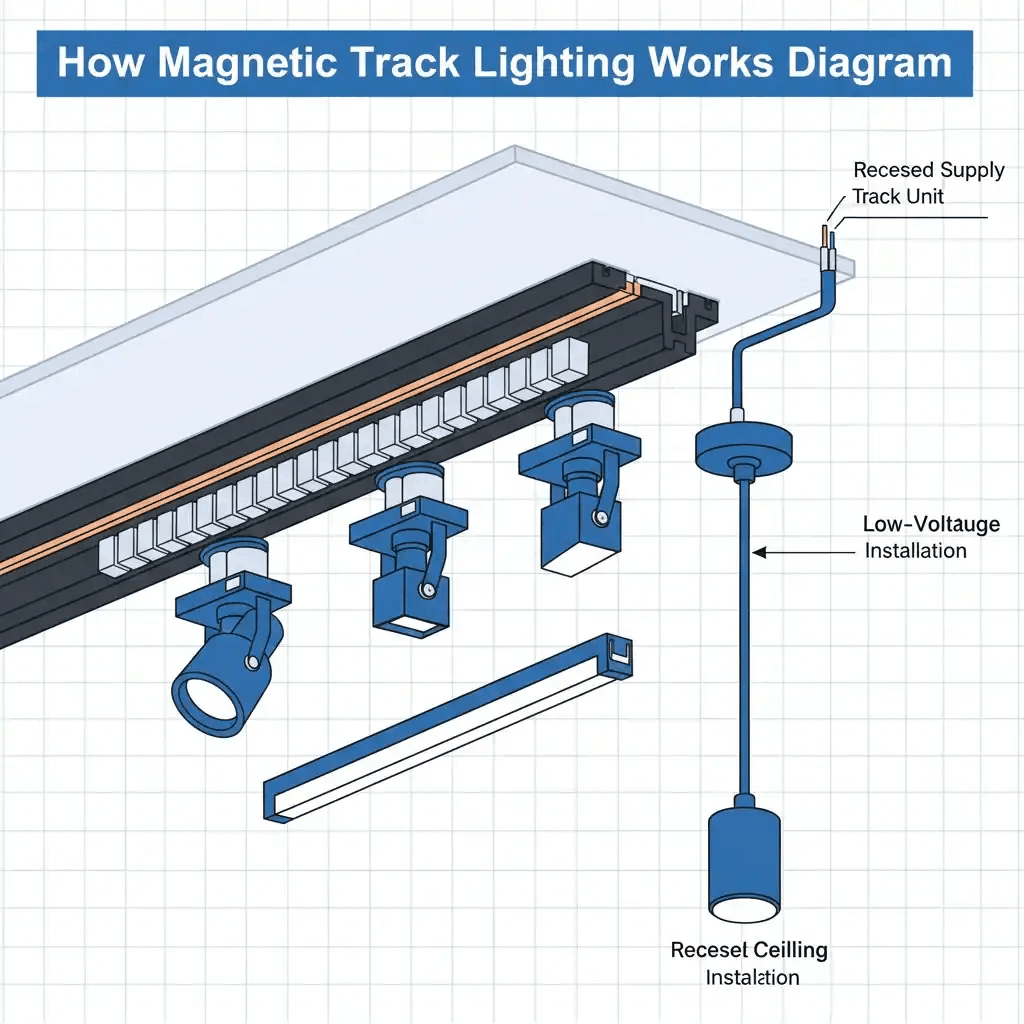
We design our mini magnetic showcase track lighting with modular parts. This follows circular economy ideals and, across the product’s life, cuts waste and shrinks the environmental footprint of lighting.

What Does the Future of Green Design Look Like for Lighting?
Future-ready showcase lighting will emphasise:
- Repairability and upgradability over disposability
- Ultra-efficient LED and driver technologies
- Integration with renewable energy systems and smart building controls
At LightrixTech, our commitment is to create lighting that performs brilliantly today — and remains responsible for tomorrow.
In Practice: What We See On The Horizon
- Modular upgrade kits: As LED module efficacy improves, fixtures designed to accept new modules without full replacement.
- Smart driver/cloud platforms: Lighting systems plug into building analytics. They support predictive maintenance and asset management.
- Renewable-friendly integration: Fixtures for solar and battery systems. Supports low-voltage DC.
- Material circularity: Reclaimed aluminum, take-back programs, recycling of drivers/LED modules.
- Standardization: As sustainable design becomes baseline expectation, clients will ask not only “how much light?” but “how long will it last and what happens at end-of-life?”
As one industry publication states: choosing high-efficacy lighting and luminaires with lower embodied carbon are two of the most impactful tactics for sustainable architectural lighting.
By applying those principles to our offering of mini showcase track lighting and mini LED pole lighting, we ensure that the product isn’t just sustainable in name, but sustainable in operation, servicing, upgrade path and end-of-life.
Conclusion
Sustainable lighting design isn’t about doing less. It’s about doing better—always. We use efficient LEDs and recyclable materials. We favor modular design, smart controls, and responsible packaging. Together, they craft lighting that looks great. It respects Earth and lasts. Built to endure.
For jewellery showcases, museum exhibits, or high-end retail, LightrixTech’s sustainable lights show that green responsibility and great design can shine together. They truly shine beautifully, and they shine brilliantly.
External Links:
- https://www.energy.gov/energysaver/led-lighting
- https://www.aia.org/article/5-tactics-sustainable-architectural-lighting
- https://www.osram.com/
- https://www.bridgelux.com/bridgleux
- https://en.wikipedia.org/wiki/Color_rendering_index
- https://ukenergylighting.co.uk/how-does-led-lighting-help-the-environment/
- https://en.wikipedia.org/wiki/Volatile_organic_compound